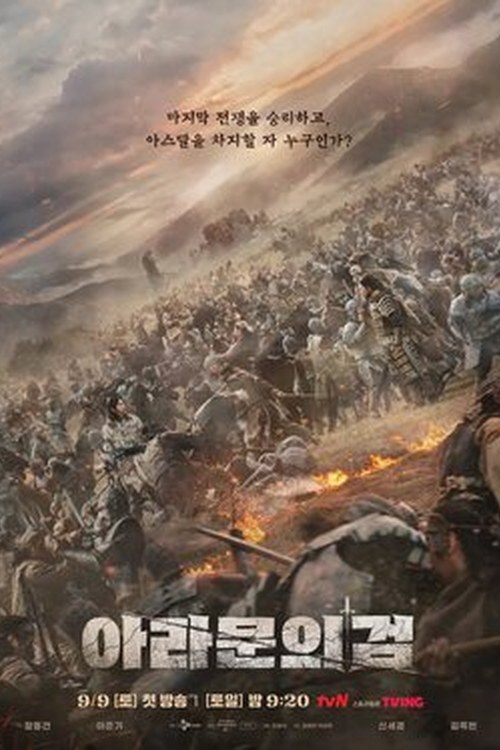
Arthdal Chronicles · Season 1 · Episode 1 · 1 June 2019
S1E1 Prophecy
A dense, muscular opener where prophecy works best as policy, though the exposition sometimes outtalks the danger.
THE MOMENT The revelation of Eun-seom's dual blood heritage - the first signal that the prophecy maps onto him directly.
The premiere world-builds at scale, dropping viewers into a Bronze Age continent divided by tribe and blood. The visuals impress; the mythology is dense but rewards patience. An unconventional opener for Korean drama that signals genuine ambition.
Full episode analysis below. Spoiler-light verdict above.
Updated
A baby is demanded before the world has explained itself. The charge is blunt: "That baby is cursed." From there, the premiere builds its engine around a cruel idea. Prophecy is not misty legend here. It becomes an order, a bargaining tool, a reason to separate children, and eventually a map toward land and manpower. BollyAI's read: "Prophecy" works best when it turns myth into administration. Its weakness is the explanation required to get there, but the spine holds.
A Baby Becomes a Border
The opening threat gives the hour its cleanest image: a child turned into a political problem before it can become a person. The demand for the cursed baby instantly defines this world. Belief does not stay in temples. It reaches into arms, families, and survival decisions.
Asa Hon is the premiere's most emotionally legible figure because her conflict is simple and painful. She refuses to hand over the Azure Comet baby, insisting on protection while everyone around her turns the child into evidence of calamity. Her resistance is not abstract kindness. It is a refusal to let prophecy decide custody.
That is why the Azure Comet detail matters. When someone says the child was born on the day the comet appeared, the line does not drift as lore. It becomes a weapon. A sky event is converted into a sentence passed on a body. The writing understands that superstition becomes most dangerous when power finds a use for it.
The premiere is less nimble when it piles up terms: Igutu, Azure Comet, calamity, tribes, gods, dreams, curses. Early dialogue can make the world feel as if it is arriving by inventory. Still, the baby gives the exposition a pulse. Whenever the hour returns to that endangered child, the mythology stops sounding like homework and starts behaving like a trap.
Abundance Comes With a Price Tag
The political pitch arrives with a softer face. Saram proposes joining hands and building a nation, with the aim put plainly: "To attain abundance." It is an elegant phrase because it sounds generous until the episode reveals the machinery beneath it. Abundance does not fall from the sky. It has to be organized, sold, taken, and justified.
This is where "Prophecy" shows ambition. The premiere does not treat nation-building as a noble montage. It begins with language. Join hands. Build a nation. Create enough. Then strategy stains the words. A plan is formed to persuade the other side through a gift, and exchange becomes the doorway to violence.
The hour's argument sharpens here. Civilization in this world introduces itself as partnership, then tests how much deceit the word can hide. That is a strong foundation for a season because it links the private danger around the baby to a wider political design. The same culture that can call a child cursed can call expansion abundance. Different vocabulary. Similar pressure.
The flaw is pacing. The political and historical material arrives in long expository stretches, and the hour occasionally trusts explanation more than action. The world is interesting, but the dialogue works hard to prove it. A premiere can be dense. This one asks for patience before it fully rewards attention.
The Gift Is the Knife
The strongest turn in the premiere is the failed gift. The plan begins as persuasion, then mutates into a sacrificial trick. Fabrics wrapped around diseased animals become the mechanism of the attack, and the outbreak that follows is blamed on the gift brought across the divide.
That is sharp writing because it makes the object carry the betrayal. A gift should say trust. Here it transports infection. The reversal does not need ornamental dialogue. The infected fabrics turn diplomacy into contamination, and the blame placed on the gift completes the cruelty. The victims are harmed, then made to look responsible for the harm.
This beat also connects neatly to the premiere's larger claim about belief and power. Disease needs a story after it appears. Someone must be blamed. Someone must explain why bodies are failing. The hour shows how quickly strategy can dress itself as fate once panic begins. A biological attack can be folded into a moral narrative, which makes the outbreak more frightening.
The sequence is also one of the places where the episode's heavier storytelling pays off. The earlier talk of plans, persuasion, and gifts could have remained dry setup. Instead, it becomes a trap with a clear physical mechanism. The audience does not need to be told that trust has been poisoned. The fabrics do the talking.
Tagon Makes Worship Look Like Command
Tagon enters the premiere's power structure with an immediately useful contradiction. He carries orders and leads hunts, but he also performs the Ollimsani to honor a warrior through worship to Aramun Haesulla, despite not being a priest. That single act tells more about him than a full speech could.
Ritual is authority, and Tagon steps into it. The moment is not merely devotional. It shows a man who understands the practical force of sacred performance. If people believe the act belongs to a priest, performing it without being one is no small transgression. It is a claim. Tagon is touching the machinery that turns violence into meaning.
The Aramun Haesulla thread is one of the hour's most intriguing open loops. Ragaz mentions Aramun threatening him in a dream, followed by the question of whether gods can exist at all, and that gives the mythology a useful instability. The premiere is strongest when it refuses to clarify whether the divine is real, useful, invented, or all-consuming. What matters immediately is that people act under its shadow.
BollyAI's read: Tagon's ritual scene is the hour's best bridge between myth and politics. It does not pause the plot to explain belief. It shows a character using belief in public, which is far more revealing.
Ten Years Later, the Machine Wants Workers
The ten-year jump gives the premiere forward motion. After the opening conflict around the baby, the infected gift, and the ritual logic of power, Asa Ron Niruha arrives to discuss the next task: workers and Iark. The shift matters because it moves the story from survival and blame into organized extraction.
Asa Ron Niruha's role is defined by control. The dossier points to plans for land and manpower, and to Tagon being entrusted with the Iark task. That turns the final movement into a cold operational handoff. The world that began by demanding a baby now talks in terms of labor. The cruelty has scaled up.
The mention of the Daekan Forces and the dujeumsaengs living in Iark plants a practical question rather than a decorative mystery. What will happen once Iark is targeted? How will people be handled when they are seen as workers before they are seen as people? The episode does not need to answer that yet. It only needs to make the direction feel inevitable.
The downside is that the final stretch leans again into agenda-setting dialogue. The premiere is laying track for a large saga, and sometimes the track is visible. Still, the ten-year transition gives the hour a strong closing shape. Prophecy opens the door, disease clears the ground, ritual sanctifies power, and the next task names the appetite.
The Verdict
"Prophecy" is a muscular but uneven opener. Its best idea is clear: in Arthdal, myth becomes policy the moment power finds a use for it. The cursed baby, the Azure Comet, the diseased gift, Tagon's Ollimsani, and the Iark worker agenda all push the same argument from different angles. That unity gives the premiere weight.
The weaker side is delivery. The early dialogue is dense, and the longer expository passages occasionally slow the danger they are meant to sharpen. But the episode has a real spine, and its major images pay rent. As a season opener, it plants the Azure Comet, Aramun Haesulla, Tagon's authority, and Iark as engines for the road ahead.