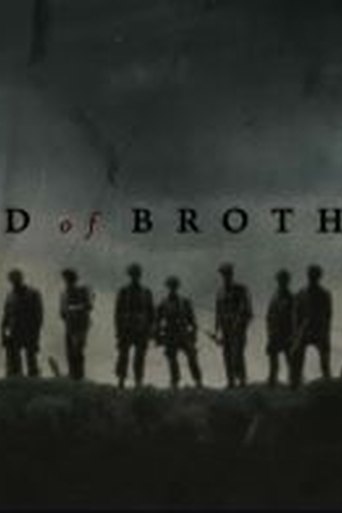
Band of Brothers · Season 1 · Episode 2 · 9 September 2001
S1E2 Day of Days
A taut battlefield hour where lost equipment, missing officers, and Winters's calm turn chaos into hard command.
THE MOMENT Winters directing the Brecourt Manor assault - the sequence military academies reportedly use as a teaching example.
The episode opens with men moving through mud like it is already history. Then, without romantic music or cinematic distance, the show compresses chaos into choices: which road, which order, which moment to act. “Day of Days” makes you feel how D-Day is not a single day in the sc
Full episode analysis below. Spoiler-light verdict above.
Updated
The plane takes fire, the green light comes on, and the jump happens before fear can become a speech. The opening does not dress the moment up. A man leaves the aircraft, the shock snaps his helmet strap, and the leg-bag goes with the blast. Equipment, radios, batteries, order, geography. The hour starts by taking away the things that make a military operation look controlled. "Day of Days" treats the invasion as subtraction. First the men lose the plane. Then they lose each other. Then they have to prove command still means something.
The Jump Eats the Plan
"Day of Days" understands that chaos lands harder when the setup has been all procedure. The pre-jump stretch is dense with checks, timing, and men waiting for an order that should convert training into action. Then the plane is hit, the pilot gives the green light, and the jump becomes immediate. That beat matters because the episode's central tension is born inside command under fire.
One man wants to jump. The order comes back that he has to stay on the plane. That contradiction is the hour in miniature: instinct pushes toward movement, command demands control, and the war outside the fuselage is already shredding both. The broken chin strap and lost leg-bag are practical proof that even a correct jump can produce the wrong battlefield.
The long silence around the jump sequence sharpens the point. The episode lets action replace explanation. No speech can compete with a body falling into the dark and arriving without the equipment it was supposed to carry. Later, when Hall explains that the prop blast took his leg-bag, radio, and batteries, the episode is still paying off the opening's violence. A missing bag becomes a missing line of communication. A physical jolt becomes a tactical wound.
That is the craft strength here. The hour itemizes disorder.
Winters Gives the Field a Center
The reveal of Lieutenant Winters is handled with restraint. Someone has to ask who that is, and the answer restores shape to a broken field. A lesser hour would build the moment like a hero entrance. Here, it plays like recognition under pressure. Identity itself becomes a form of order.
That choice is the episode's cleanest piece of character writing. Winters does not need a grand declaration because the situation has already made the question urgent. Men are separated from radios and equipment. They are waiting for reloads. The expected structure has holes in it. So when Winters is identified, the episode turns a simple reunion into a command beat. His importance comes from need. The scattered men now have a name to gather around.
The scene also keeps the hour from dissolving into pure confusion. The early stretch could have become disconnected fragments: jump, loss, reload, separation, missing people. Winters gives those fragments a spine. The episode's best instinct is to make leadership feel logistical before it feels inspirational. Who is here? Who is missing? What equipment remains? What can still be done?
That is why the reveal lands. The field corrects around him.
Missing Men Make the Chain of Command Bleed
The most haunting absence in the episode is Lieutenant Meehan. His contradiction is built into the hour's structure: he is tied to the timing and control of the jump, then he becomes unaccounted for. No one has seen him. His plane becomes a question the episode refuses to close.
That open loop matters because it prevents Winters's emergence from feeling clean. Command does not pass like a ceremonial object. It leaks through uncertainty. Lip asking whether Evans made it, and the reply that he is in Meehan's stick, keeps the episode's anxiety attached to names and assignments. These men are bodies inside an order of sticks, roles, equipment chains, and expected positions. When one piece disappears, every other piece has to be checked again.
The episode is also sharp about how grief enters through administration. The question does not arrive first as a full emotional collapse. It comes through accounting. Who made it? Who is with whom? Who has been seen? That is the correct language for this world, and it is colder because of it. The men are trying to make a list while the list keeps changing.
This is where "Day of Days" earns its title without inflating it. The day is historic, but the episode keeps returning to smaller units of loss: a missing officer, a vanished radio, a man whose whereabouts cannot be confirmed. The large event is felt through damaged procedure.
Guarnere Tests Discipline at the Wrong Volume
Guarnere gives the hour one of its sharper internal frictions. He wants to preserve command discipline, yet he keeps being corrected for acting before the command. The contradiction is useful because it grows out of impatience rather than cartoon hypocrisy. He is trying to force order back into a situation that has already humiliated order.
The repeated correction around waiting for command does necessary work. It shows that discipline is not a slogan the episode can simply praise. It is behavior, and behavior cracks under pressure. Guarnere's energy is valuable, but the hour keeps making the same point: urgency without timing can become another form of disorder.
This section also reveals one of the episode's few limitations. The dialogue density during equipment checks, movement, and briefing keeps the military procedure legible, but it can make the middle of the hour feel more functional than dramatic. The briefing after which the men pack up for the assault prep is necessary, and the transition into coordinated movement is clear. Still, the episode sometimes leans on spoken logistics after silence has already done heavier work.
The assault preparation benefits from the exactness. The men have been separated from equipment and radios, Meehan is missing, Winters has become the organizing presence, and now the plan against the guns has to move from talk to execution. The plan breaks. The repaired version has to survive contact.
A Name Finally Catches the Grief
Near the end, a man says he lost someone today, and the answer lands on Hall. It is a small exchange, but it ties the episode's practical losses to a human one. Earlier, Hall's problem is explained through equipment: the prop blast took the leg-bag, radio, and batteries. Later, his name is attached to death. That movement is blunt, and the bluntness is the point.
The episode does not overwork the grief. It does not pause to turn Hall into a symbol bigger than the evidence can carry. It lets the name do the work. After an hour of men asking who made it, who is where, and what can still be used, the final accounting narrows to one loss that cannot be fixed by reloading, regrouping, or assigning a new role.
This is also where the action-to-exposition pacing pays off. The hour has moved through silence, command, briefing, and forward motion. By placing grief after all that coordination, it makes loss feel like the cost of function. The men can still act. The mission can still proceed. The chain can hold in a damaged form. The body is still missing from the line.
The Verdict
"Day of Days" is a disciplined hour about command after the plan breaks. Its best craft choice is to make the invasion feel physical before it feels historical: a broken chin strap, a lost leg-bag, missing radios, unseen officers, and men trying to restore a chain of command in the dark. Winters's emergence is handled with restraint, Meehan's absence gives the episode a wound that stays open, and Hall's final naming turns logistical damage into grief.
The middle stretch can feel heavy with necessary briefing and movement language, especially after the silent force of the jump. Even so, the hour earns its structure. In the season arc, this is the episode that moves Easy Company from training-shaped identity into battlefield improvisation, where leadership is proved by what survives the drop.