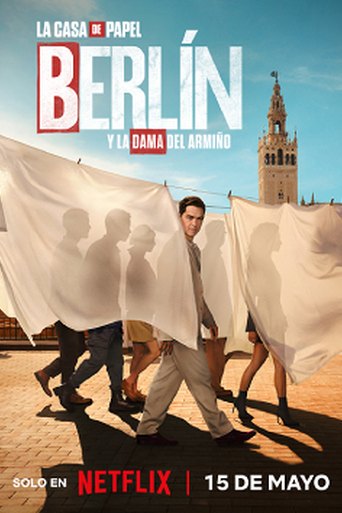
Berlin · Season 1 · Episode 5 · 29 December 2023
S1E5 A Love Story
Lolle's dream gets redirected into work, snacks, and an orange peel, giving the hour sharp chaos with rushed emotional fallout.
The season's central romance thread reaches its most vulnerable point. Berlin's capacity for genuine feeling - long buried under layers of performance and self-mythology - surfaces with unexpected sincerity. The Paris setting is used for maximum romantic tension, while the heist complications create pressure that tests every relationship in the crew.
Full episode analysis below. Spoiler-light verdict above.
Updated
Lolle says the cleanest thing in the episode before it has time to make a mess of it: "I want to draw comics." The line is small, direct, and dangerous. No grand speech surrounds it. A young woman names the life she wants, then immediately learns that desire has rent attached. Her parents will not pay if she does not work. Her mother suggests the roof when Lolle asks to work elsewhere. By the time the episode is chasing an orange peel for Sandra Bullock, the joke has already bitten. This is an episode about ambition redirected into errands.
The Dream Gets an Invoice
"A Love Story" begins with Lolle trying to define herself by work she wants. She does not say she wants to be useful, respectable, or sensible. She wants to draw comics. That specificity matters, because the episode spends the rest of its runtime sanding the dream into something more employable. Lolle wants to be a comic artist. The practical outcome is a graphic-design job for Sven.
The parental pushback gives the episode pressure without needing a bigger plot machine. If Lolle does not work, she does not get paid. The family conversation is blunt rather than ideological. Money becomes the editor of Lolle's dream. Her wish has linework and imagination. Her family's answer has conditions.
That makes the later confirmation that she works for Sven land as a compromise. Graphic design is adjacent to drawing, close enough to defend and far enough to sting. The episode understands the tiny humiliation of taking a job that resembles your dream only from a distance. Lolle is not abandoning art in a melodramatic collapse. She is letting reality rebrand it.
The writing's best early move is restraint. It lets the gap between "draw comics" and "work for Sven" carry the meaning. The weakness is speed. The episode's rapid talk rushes past the emotional aftertaste. The idea deserves one quiet beat. The episode gives it a sprint.
Sven Turns a Workplace Into a Snack
Sven's side of the episode is built on a neat dodge: he wants to keep staff, but masks his company as a "snack" to justify junk-food orders. It is silly, and it fits the episode's governing habit. Everyone keeps renaming a problem until it becomes easier to survive. Lolle's art becomes design. Sven's business concern becomes a snack excuse. Serious things put on ridiculous costumes and hope nobody checks the label.
That is where the comedy works best. The joke is Sven trying to manage workplace anxiety through absurd language. He is not presented as a mastermind. He is improvising, and the improvisation has grease on its fingers. The episode's dialogue-dense rhythm helps him. With almost no silences, every dodge has to come out quickly, before someone asks the sensible next question.
The Sven material also complicates Lolle's new job. If she is stepping into his orbit as a graphic designer, her compromise is tied to his chaos. The job is not a clean professional lane. It is another Berlin contraption held together by talk, panic, and a snack-shaped lie. That gives the episode an honest comic texture. Work is available. The workplace is already performing a magic trick with empty pockets.
Still, the "snack" façade risks being funnier as a premise than as a sustained engine. The mask and the junk-food justification land as a glimpse of Sven's avoidance. To become a full comic runner, the beat needs another turn. As an emblem, it works. As an engine, it sputters.
An Orange Peel Becomes the Plot's Steering Wheel
Then the episode swerves toward Sandra Bullock's orange peel, and the absurdity is so specific that it starts to feel like the point. The group discusses needing an orange peel for Bullock. Later, they decide to drive to get it. On paper, this is nonsense. In the episode's rhythm, it becomes the perfect object: tiny, useless, oddly urgent, and strange enough to drag everyone into motion.
The orange peel works because it shrinks celebrity glamour into rubbish. Sandra Bullock is the name that brings scale. The peel is the punchline that punctures it. The episode does not need a grand statement about fame. It only has to let frantic people treat a piece of discarded fruit as mission-critical. That is good sitcom physics. The smaller the object, the larger the panic can become.
More importantly, the orange-peel quest externalizes the episode's emotional state. Lolle cannot yet steer her life toward comics. Sven cannot plainly admit what he needs from his staff. The group can drive for a peel. The errand becomes a pressure valve for every unresolved question the episode plants. Motion replaces clarity.
This is the episode's cleanest comic idea. Farce needs an object everyone can overvalue. The danger is that the object can swallow the character work. Here, the Sandra Bullock bit is strongest when it reflects the larger chaos, weaker when it edges toward random celebrity business. The episode mostly stays on the right side because the peel arrives after Lolle's work crisis has set the emotional terms.
The Sad Father Cuts Through the Noise
The emotional counterweight arrives when Lolle worries about her father's sadness. The observation is plain: her dad looked sad. After so much planning, work pressure, and orange-peel madness, that matters because it is not strategic. It does not solve anything. It simply notices pain.
This beat is important for Lolle. The episode has already positioned her between private ambition and financial pressure. Now it adds family instability, with the parents' split left as an open question. Lolle's worry does not erase her desire to draw comics, but it crowds the room around it. She is trying to imagine a future while her household looks emotionally unstable.
The title, "A Love Story," gets more interesting through that contrast. From the available beats, this is not a straightforward romantic episode. Love shows up as concern, dependence, pressure, obligation, and panic disguised as practical advice. A parent refusing financial support can still be part of a family system. A daughter worrying about her father can still resent the limits around her. The episode lets love be inconvenient.
The criticism is in the handling. The tone note says the episode has virtually no silences, and that can flatten a beat like the father worry. Some emotions need air. The chaotic rhythm mirrors the characters, but it can also treat sadness as another item on the agenda. The beat still registers because it is direct. It would cut deeper if the episode paused long enough for Lolle to absorb it.
The Verdict
"A Love Story" is a busy, prickly episode built around one strong contradiction: Lolle names a creative dream, then gets pulled into the practical machinery around it. The graphic-design job, Sven's snack façade, the father's sadness, and the Sandra Bullock orange-peel quest all circle the same comic truth. Nobody here deals with life head-on when a detour is available.
The episode's strength is its specific absurdity. The orange peel is ridiculous in exactly the right way, and Sven's workplace lie gives Lolle's compromise a messy comic setting. Its weakness is pace. The dialogue-heavy churn gives the episode snap, but it steals weight from the family material. Score: 7.3. For the season, the episode keeps Lolle's comic-artist question open while pushing the parents' split and Sven's workplace lie forward.