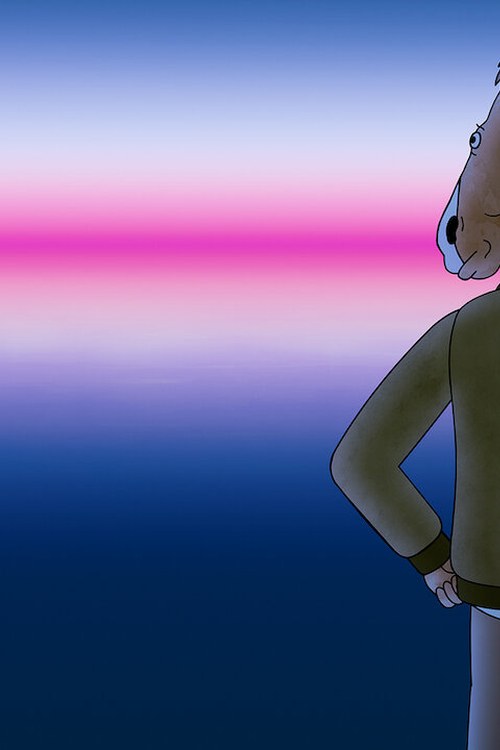
BoJack Horseman · Season 1 · Episode 1 · 22 August 2014
S1E1 BoJack Horseman: The BoJack Horseman Story, Chapter One
A sharp but overloaded pilot finds BoJack’s wound inside a ghostwriter deadline and an anxiety gag that actually bites.
THE MOMENT BoJack's self-pity monologue that tips from comedy into something disturbingly sincere.
The premiere introduces the washed-up star of Horsin' Around, his ghostwriter Diane, and the parasitic agent Princess Carolyn. The show establishes its Hollywoo absurdism quickly but reserves its emotional gut-punch for episodes ahead.
Full episode analysis below. Spoiler-light verdict above.
Updated
BoJack Horseman cannot finish the thing designed to make people love him again. That is the pilot's cleanest joke and its cleanest wound. A memoir should give him control: his story, his timing, his version of the applause. Instead, the deadline corners him, the ghostwriter becomes necessary, and stress turns ordinary pressure into a death-scene fantasy. The episode's thesis lands there. BoJack wants authorship over his own myth, but every scene shows him outsourcing motion to chaos, friends, deadlines, and finally a stranger walking through the door.
The Sitcom Frame Is a Trap
The first move is to dress the episode in familiar comfort. Horsin' Around is described through studio-sitcom framing, placing BoJack inside a format built on applause, tidy rhythms, and problems that resolve before the next beat. The pilot starts poking holes in that comfort almost immediately. Charlie calls out BoJack's handicapped-spot parking wording, and BoJack does what he keeps doing all episode: he argues the terms instead of facing the problem.
That exchange matters because it sets the operating system. BoJack treats language as a loophole. If he can contest the wording, he can delay the moral fact underneath it. The episode's comedy is dense and fast, but the best early gags have that same shape: a verbal dodge revealing a character who cannot sit still inside accountability.
Then the episode swerves into a Maury-style paternity segment for Phoenix, complete with the blunt "you are the father" mechanism. It is a ridiculous interruption, but it sharpens the pilot's method. Public performance keeps invading private dysfunction. The show turns confession into spectacle, responsibility into a punchline, and shame into programming. That gives the opener a useful first gear for a series about a man who wants to be understood without being examined too closely.
The risk is that the pilot sometimes mistakes frantic motion for sharper definition. Its cutaways and showbiz jokes arrive quickly, and not all of them land with the same force. Still, the frame is clear. BoJack lives inside a world where pain is content, and he has spent too long benefiting from that arrangement to know how to escape it.
The Restaurant Scene Lets Awkwardness Do the Cutting
The restaurant escalation is where the pilot starts using social friction as plot. BoJack and the others get pulled into a breakup scenario that spins toward the "baby" topic, which is exactly the kind of conversation nobody wants at dinner and therefore the exact kind this episode wants to trap them inside. The setting is ordinary. The behavior is not. That gap is the joke.
Mr. Peanutbutter gets his first real shape here through attempted smoothness. He wants to handle a breakup without awkwardness, tries to join or continue conversation, and ends up framed through the "crossover episode" tension as the room gets worse. The funny part is that his social energy treats discomfort like a door that must be opened wider. He does not read the room so much as flood it.
This is also where the pilot's overload becomes visible. The rapid exchanges and escalating absurdity create momentum, but the episode sometimes trusts velocity when it should trust pressure. A breakup, a baby topic, and a crossover-style collision are enough material for a cleaner scene. Here, the writing keeps adding sparks until the fire is harder to read.
Still, the scene earns its place because it externalizes BoJack's central problem. He wants affection, attention, and control, but he keeps finding himself in rooms where other people's needs take over the frame. The pilot does not ask him to grow yet. It asks him to fail in public. That choice matters. A more sentimental opener might move too quickly toward confession or repair. This one lets embarrassment do the work first.
The restaurant scene also helps define the show's social ecosystem. Nobody gets the clean role of straight man for long. Everyone has a bit, a wound, a tactic, or a blind spot. That makes the scene messy, but it also keeps BoJack from becoming the only source of dysfunction. He is the center of the episode, not the only problem in the room.
The Memoir Is Control Wearing a Deadline
The dinner-table shift into the ghostwriter problem is the episode's spine locking into place. The book deal has deadlines. BoJack has avoidance. The distance between those facts is where the pilot finds its best character comedy. He wants to preserve his memoir as a self-driven account, a version of himself that can be packaged and loved. Wanting the finished book is not the same as writing it.
The cleverness is in making the ghostwriter practical before it becomes thematic. The deadline requires a solution. Others push the solution. BoJack resists because accepting help means surrendering the fantasy that he remains in control of his comeback story. That is the contradiction the episode understands best: he wants the public reward of vulnerability without the private work that vulnerability demands.
The "Toast" stress spike turns that avoidance into a body gag. A detail derails him, focus collapses, and the episode moves from book logistics into crisis mode. This is where the pilot's absurdity pays rent. The stress is not a random cartoon eruption. It is the physical consequence of a man trying to control a narrative he cannot even begin.
That is why the memoir material carries more weight than the restaurant chaos. The restaurant exposes BoJack socially. The book exposes him structurally. Every excuse he makes around the memoir shows how fragile his self-image is. He wants the prestige of reflection, but reflection requires contact with facts he has spent years converting into anecdotes.
The whole episode bends toward one question: if BoJack cannot tell his story, who will? That question gives the pilot a shape beyond its joke density. It points toward Diane before she fully enters the show, and it turns the memoir from a career problem into a threat. Someone else may be able to see him clearly. For BoJack, that is useful and terrifying.
Anxiety Gets the Punchline, Then the Diagnosis
The death illusion around the "Toast" stress spike is broad, but the reversal is pointed. BoJack collapses into panic, the scene plays like an absurd end-of-life emergency, and then the doctor explains that he experienced a mild anxiety attack. The gap between BoJack's internal catastrophe and the medical explanation is the joke, but it is also the pilot's most useful character note.
The episode is honest enough to make the panic silly without making it meaningless. BoJack's fear is outsized. His avoidance is real. The doctor naming it does not solve it, and that is the point. A diagnosis can puncture the theatricality, but it cannot write the memoir.
Todd becomes important because he handles BoJack through practicalities. Beer, party management, ghostwriting momentum, introductions: Todd's function is not clean emotional wisdom. It is motion. He keeps interrupting BoJack's spiral with errands and next steps, which makes him funny and quietly necessary. When Todd announces BoJack is out of beer and introduces Diane Nguyen as Mr. Peanutbutter's girlfriend, the pilot plants the next complication with a casual knock at the door.
That final introduction is a neat ending because it refuses grandeur. After all the noise about legacy, love, stress, and death, the next turn arrives through a practical interruption. BoJack wants a controlled memoir. The episode ends by placing the ghostwriter-adjacent future, Todd's social setup, and Diane's arrival in the same messy room.
Diane's entrance also gives the pilot a needed shift in texture. Until then, the episode runs on evasion, interruption, and social overreach. Diane suggests scrutiny. She is not framed as a magical corrective to BoJack, and the episode is better for that restraint. Her presence raises the pressure without resolving it.
The Verdict
"The BoJack Horseman Story, Chapter One" is a solid, uneven pilot with a sharper center than its scattershot rhythm first suggests. The best material understands BoJack's contradiction: he wants his life arranged into a lovable story, but the act of arranging it makes him panic. The weaker stretches push too many comic escalations into the frame, especially when the restaurant material could have cut cleaner with fewer moving parts. Still, the ghostwriter deadline gives the episode a real engine, and the anxiety reversal gives the comedy a bite beyond noise. As a season opener, it plants the memoir, BoJack's hunger to be loved, and Diane's role without pretending those pieces are stable yet. BollyAI's score: 7.2.