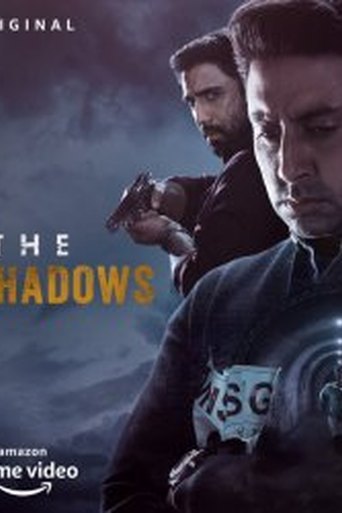
Breathe: Into the Shadows · Season 1 · Episode 11 · 10 July 2020
S1E11 Episode 11
A psychologically taut hour that turns the protector's mission into a suicide pact, hamstrung only by a pedestrian procedural subplot.
'It is not joy but pain that binds us together.' The line lands in the opening silence and inverts the episode's entire architecture. The season's shadowy antagonist steps forward to explain himself, and the episode compresses its season-long themes into a tight psychological duet between captor and captive. The Ravan suicide pact gives the thriller its most thematically coherent moment...
Full episode analysis below. Spoiler-light verdict above.
Updated
“Pa, it is not joy but pain that binds us together.” The line lands in the long silence of the hour’s opening, and the episode’s entire architecture inverts. The speaker, the shadowy figure who has spent the season orchestrating Ravan’s killings from the sidelines, was born, he says, to keep Avinash safe. That bond was supposed to be a fortress. Now he stands in the room with the boy’s father and proposes to burn the fortress down, using Avinash’s gift for emotional manipulation as kindling, and walking himself into the fire. What follows is not the show’s loudest hour. It is its most psychologically compressed, a fifty-minute thesis on a protector who cannot stop protecting even as he plans his own erasure.
A Bond Reframed in Pain
The first act turns on the speaker’s redefinition of his purpose. Pa listens, stone-faced, as the series’ most opaque presence becomes its most vulnerable. The early lines, delivered almost as recitation, lay out the contract: “the sole purpose of my birth was to keep Avinash safe.” The dossier marks this as a core motivation, but the episode refuses sentimentality. The speaker names his plan with clinical precision. Avinash “possesses the talent to play with people’s emotions,” and that talent will be weaponised to bring down the remaining heads of Ravan. The coldness is the point. This is not a plea. It is a transfer of debt.
The writing earns its dramatic weight by keeping the emotional register flat. When the speaker says “We will become one forever,” the line is not a romantic promise but an operational directive. The mythology of Ravan’s ten heads, each representing a sin being purged, gives the arc a mythic spine. The episode subordinates the symbolism to the intimacy of the room. The real horror is not in the killings outside but in the pact being sealed between two men who both believe they are protecting the same child, even as they destroy each other.
The Ravan Countdown
The episode’s structural gamble is the open loop it plants and refuses to close: “As the 10 heads of Ravan die, I will die, too.” That line transforms every subsequent beat into a clock. The speaker is not merely a killer. He is a suicide whose fuse is the mission he designed. The episode returns repeatedly to the image of a man counting down his own existence.
This focus is rare. Earlier episodes sprawled across police stations and suburban homes. This one pulls inward, orbiting the speaker-Pa axis. The repeated returns to the Ravan count act as a drumbeat. One reservation: the count is spoken more often than it is shown. A single visual motif, a talisman or a marked wall, would have anchored the abstraction. Still, the gamble pays. By the time the speaker links his life to the last head, the stakes feel less like a plot twist and more like a philosophical conclusion the series has been building toward since the first kidnapping.
Silence as a Character
A 147-second gap of silence stretches between two dialogue peaks, and that silence is the episode’s most distinctive craft choice. In a show that often runs on rapid-fire confrontations, these long stillnesses act as decompression chambers. The camera holds on Pa’s face, on the speaker’s hands. The absence of dialogue forces you to sit inside the horror of what has just been proposed.
This rhythm is a high-wire act. Done poorly, it would feel like padding. Here it works because the silences are not empty. They are filled with the residue of the lines that came before. After “pain that binds us together,” the episode lets the air go dead, and the words echo. The risk: the same technique, repeated, begins to feel like a signature rather than a necessity. The second and third long pauses have slightly diminishing returns. But the first is genuinely unsettling. It announces the episode’s ambition to be a pressure cooker rather than a chase.
The Cop Show on the Margins
And then, jarringly, the other half of the episode arrives. The investigation. Kabir is in the hospital, discharge a few days away. Kesari receives an apology from the department. A DNA report is requested. The beats are functional, procedural. They land with a different gravitational pull. Where the speaker-Pa scenes are coiled and mythic, the cop scenes are flat earth, grounded in paperwork and roast chicken orders.
This parallel storytelling, a staple of the series, feels like a necessary evil here. The investigation’s slow churn is probably seeding a payoff. Kabir’s recovery, Kesari’s redemption arc. In this hour, it interrupts the central tension rather than feeding it. The episode would be stronger if it trusted its own compression, letting the Ravan pact occupy the full frame. One grace note: “He’s popular. Serious doctor, and serial killer!” lands as a grim joke, briefly acknowledging the absurdity the show has built. It is the only moment the procedural side earns its place.
The Protector’s Fatal Contradiction
The central contradiction is that the speaker wants to keep Avinash safe by doing the very thing that will end his own protective presence. He seeks his own death through his mission, and the episode does not flinch. No eleventh-hour revelation suggests he might survive. The logic is airtight: he will die when Ravan’s heads are destroyed, and he is the one lighting the fuse.
This is not tragic heroism. It is a pathology dressed as sacrifice. The writing is sharp enough to let that ambiguity breathe. Pa’s silence becomes the verdict. The series has spent eleven episodes building a world of moral murk, and this hour finally admits that the clearest intentions produce the most devastating outcomes. The myth of protection, of a father, of a guardian, is exposed as a kind of fatal love, the sort that binds with pain because joy was never on the table.
The Verdict
Breathe Into The Shadows S01E11 compresses its season-long themes into a tight psychological duet. The result is the most thematically coherent hour since the premiere. The Ravan suicide pact gives the episode mythic gravity. The deliberate use of silence demonstrates a craft maturity the series has only gestured at before. But the procedural subplot with Kabir and Kesari, while inching forward necessary plot machinery, siphons momentum at precisely the wrong moments. The episode would be braver as a full, uncompromising chamber piece. It is a very good episode that stops short of greatness. At the season level, this hour plants the final seeds for a resolution that will either vindicate the speaker’s fatal logic or collapse into chaos. The show has finally committed to its dark thesis.
Bollymeter: 7.4/10.