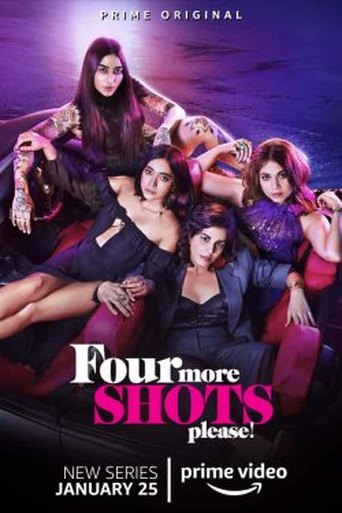
Four More Shots Please! · Season 1 · Episode 4 · 25 January 2019
S1E4 Ex Why Zzz
A sharp, uneven chapter where Anjana’s contradictions carry more charge than the episode’s louder comic detours.
# Four More Shots Please S01E04: "Episode 4" Review *Spoiler-light verdict above. Full episode analysis below.* Episode 4 opens by naming its problem.
Full episode analysis below. Spoiler-light verdict above.
Updated
Someone says people get stuck in the past, and the episode spends the rest of its runtime proving the line with messy, comic impatience. Anjana wants distance from her father. Someone worries she may lack maternal instinct. A bikini greeting breaks the heaviness, a double espresso joke resets the rhythm, and a trainer lands the hour’s cleanest word: consent. The episode keeps throwing escape routes at its characters, then shows how fast they run back toward habit. BollyAI’s read: Episode 4 works best when contradiction becomes character. It stumbles when the gags arrive before the feeling has settled.
The Past Refuses to Leave the Room
The opening thought, that people get stuck in the past, gives the hour its spine. Episode 4 is built around characters who talk about moving forward while dragging old emotional furniture behind them. The later photo album conflict makes that idea physical. Memory becomes an object people can fight over, preserve, hide, or use as proof that the past still gets a vote.
That shape suits a mid-season episode. The hour does more than push plot. It asks what kind of past each character is carrying and how each one has learned to justify carrying it. Anjana’s declaration that she has come to take a break from her father fits cleanly into that pattern. She wants distance from a person, but she is also trying to pause a version of herself formed around him.
The episode’s strength is its refusal to make moving on sound tidy. A character can say the right thing and still act from the old wound. A photo album can look harmless and still become a battlefield. Four More Shots Please finds its sharper mode in the minute after independence is declared, when nobody knows what independence is supposed to look like.
That is why the album dispute matters. It gives the episode a concrete emotional object, which helps ground the more scattered comic business around it. The show can be loose, loud, and flirtatious, but this thread reminds the hour that family history does not stay politely in the background. It enters the room. It takes up space.
Anjana’s Escape Plan Has a Leak
Anjana is the hour’s most useful mess because her contradictions are specific. She wants to quit drinking wine for a year and a half, then reaches for cheap beer and cheap sex in the same emotional zone. That turn is funny, and the joke has a point. Her rebellion is a rebrand of the same old panic.
The line about taking a break from her father gives her story a clear external target, but the episode gets more interesting when that target blurs. If the problem were only her father, distance might solve it. The real issue sits in how she processes pressure. Every escape route can turn into another loop. The cheap beer detail punctures the nobility of her plan. She is trying to feel free quickly, which makes the freedom look suspicious from the start.
The episode also threads in the fear around maternal instinct. The question, "What if I'm not maternal?", carries more weight than the surrounding comic noise because it admits a kind of panic the show cannot joke away. It links the unexpected pregnancy thread to identity rather than simple scandal. That is the better version of the episode: exposed, impatient, willing to let a woman be inconsistent without treating inconsistency as a writing error.
Where it slips is in how rapidly the hour moves away from these beats. Anjana’s spiral has charge, but the pacing sometimes treats it like another station on the comedy circuit. The contradiction lands. It could have cut deeper with one more breath.
Her story also sharpens the episode’s larger argument about choice. Anjana keeps trying to make decisions that look decisive from the outside, yet they often feel reactive. Quit wine. Leave home. Grab the cheaper drink. Seek sex as release. Consider marriage under pressure. None of these beats need a speech to connect. The pattern is visible enough, and the episode is strongest when it trusts the viewer to see it.
Consent Is the Cleanest Word in the Room
The trainer’s emphasis on "Consent." gives Episode 4 its moral anchor. The word is short, almost blunt, and the hour needs that bluntness because so much around it is slippery. Flirting, proposal energy, novelty condoms, panic, desire, and family pressure all orbit the same basic question: who gets to choose, and who is being nudged into a role before she has agreed to it?
That makes Mohit a useful foil. His contradiction is drawn plainly: he wants a stable relationship, but keeps buying novelty condoms and flirting. The show does not have to turn him into a villain for that to matter. The mismatch is the point. Stability, in his hands, still comes wrapped in impulse. He wants the comfort of commitment while dragging along habits that make commitment unstable.
The open question of whether Anjana will actually marry Mohit after the chaotic proposal gives the episode a proper hook. The sharper drama sits under the yes or no. Does the proposal belong to the life Anjana wants, or the life everyone keeps arranging around her? That is why the consent beat matters. It cuts through the chatter. It tells the episode, and the characters, that charm is not permission.
BollyAI’s read: this is the hour’s cleanest piece of writing. One word does the work a longer speech would have softened.
The episode also uses Mohit to complicate the romance without overexplaining him. He can be affectionate. He can be careless. He can want the future and still treat the present like a game. That ambiguity gives the proposal its uneasy charge. The scene is chaotic because the relationship is chaotic, and because Anjana’s answer cannot be separated from the pressure surrounding it.
The Jokes Keep Cutting the Brake Lines
Episode 4 alternates rapid, profanity-laden dialogue with a 72-second silence, and that contrast gives the hour its roller-coaster feel. The talky sections come fast: the bikini greeting, the double espresso joke, the naming gag around cousin Xerxes. These details keep the show in its breezy, urban register. They also keep reminding us that the characters use noise as a survival tool.
The double espresso joke is a neat pacing valve. It gives the episode a caffeine shot right when the emotional material risks becoming too heavy. The bikini greeting does similar work, breaking tension through playful self-awareness. Xerxes, introduced as a naming joke, adds another comic jab. The show knows the value of a quick laugh before the next emotional swerve.
This is also where the episode’s unevenness shows. The comic detours have purpose, yet they sometimes arrive so quickly that the heavier beats lose oxygen. The question of motherhood, the break from the father, the proposal chaos, and the photo album dispute all need room. When the hour trusts silence, it becomes more confident. That 72-second pause has more authority than some of the busier exchanges around it.
The best rhythm here is interruption with consequence. The weaker rhythm is interruption as reflex. Episode 4 contains both patterns, and the score has to account for that wobble.
The show’s speed is part of its identity, so slowing it down too much would flatten the texture. The issue is placement. A joke after an emotional beat can release pressure. A joke before the beat has landed can feel like avoidance. Episode 4 understands that difference in flashes, especially when the silence takes over. Then it gets restless again.
The Verdict
Episode 4 is a solid, prickly mid-season chapter with one strong argument: nobody here escapes the past by announcing an escape. Anjana’s contradictions give the hour its pulse, and the consent beat gives it a needed ethical center. The photo album dispute smartly turns memory into conflict, while the pregnancy and proposal questions keep the season’s future loaded.
The flaws are real. Some jokes cut in too soon, and the episode occasionally confuses speed with momentum. Still, when it slows down, it finds the sharper show inside the louder one. As a season piece, it plants live wires in Anjana and Mohit’s marriage question, the unresolved pregnancy, and the family conflict around the album. BollyAI’s read: a 7.0, carried by character contradiction and held back by restless pacing.