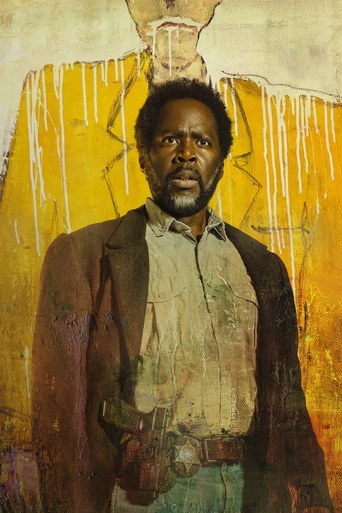
From · Season 1 · Episode 5 · 6 March 2022
S1E5 Silhouettes
Sara's bargain curdles into tragedy, making Silhouettes a sharp, cruel hour about the cost of believing signs.
THE MOMENT The question at 11:29. Rewatch it knowing what Sara is actually asking, and the scene changes temperature entirely.
The season's most carefully laid trap, built from a hypothetical. Sara asks Boyd whether one bad thing would be worth everyone going home, and his easy answer, a lot of good for one bad thing, becomes a consent he does not know he gave. The bar-room Schrodinger's cat digression reframes the entire show in one scene: escape is not a...
Full episode analysis below. Spoiler-light verdict above.
Updated
Sara locks Tabitha away and walks Ethan to the barn. She does not look like a monster in that moment. That is the nasty little engine of "Silhouettes." The episode makes her calm, frightened, convinced, and wrong. Then Nathan arrives, the one person still trying to pull her back, and the cost lands in the exact place she never meant it to land. This is the hour where From stops treating Sara's secret as a creepy subplot and turns it into the season's most dangerous moral argument.
A Bad Question Gets an Answer
The key scene arrives early, before the barn, before the blood, before the night swallows Sara into the woods. Sara asks Kristi a question that sounds hypothetical only because she needs it to: "even if it was something bad, would you do it?" The line works because it is so plain. She is not floating a spooky riddle. She is shopping for permission.
The episode lets Kristi hear the pain in the question without knowing its shape. Kristi wants to help. Sara wants a verdict before she commits the crime. That mismatch gives the scene its charge. The doctor hears trauma. Sara is already somewhere more dangerous, measuring murder against the possibility of home.
That is the episode's thesis in miniature. The town traps bodies, then starts rewriting the math people use to judge themselves. Sara believes she is saving everyone. The action she chooses is the attempted killing of a child. "Silhouettes" is strongest when it refuses to soften that contradiction. It does not ask for forgiveness on Sara's behalf. It also does not flatten her into pure evil. The horror sits in the gap between motive and method.
Kristi's role sharpens that gap later, when she understands that the scalpel came from her clinic. Her care became access. The episode does not overplay that guilt, but the beat matters. In From, kindness can become a weapon without changing its original intent. Cold rule. Cruel town.
The Quiet Board Before the Cut
Before the episode snaps into violence, Jim starts a problem-solving board with Ethan. The quiet stretch gives the hour room to breathe, and the placement is smart. After Sara's collapse at the diner and before her plan hardens, the show pauses on a father and son trying to make the impossible look legible.
That board is a small act of defiance. Jim and Ethan cannot solve the place, but arranging questions on a surface gives panic a shape. The silence around it matters because the episode is otherwise built on pressure: Sara's secret, Nathan's worry, Kristi's misread, Boyd waiting for direction. The board scene slows the blood flow before the cut comes.
There is a nice cruelty in pairing Ethan with problem-solving while Sara decides he is the solution. To Jim, Ethan is a child who can be included, steadied, maybe protected through thought. To Sara, under whatever force or belief has gripped her, Ethan becomes the final requirement. The hour does not need to explain the full machinery behind that belief yet. It only needs to make the distortion clear.
The board material is more useful as rhythm than drama. It gives the episode a contemplative pause, but it cannot compete with Sara and Nathan for emotional gravity. That imbalance means the middle belongs less to discovery than to waiting for Sara's decision to catch up with the viewer's dread.
The Barn Turns Hope Rotten
When Sara takes Ethan to the barn, "Silhouettes" cashes in the question it planted with Kristi. This is where the episode earns its title feeling: people are recognizable by outline, but the full shape of them is hidden until the light hits wrong.
Sara's explanation to Ethan is terrifying because it has the structure of reassurance. "They told me, this was the last one, then everyone gets to go home!" She is selling the act as rescue. That line does the episode's heaviest lifting. It reveals belief, motive, and delusion in one breath. Sara is not improvising. She has accepted a command, or accepted something as a command, and built a moral staircase down to the barn.
Nathan's intervention gives the sequence its tragedy. The episode has underlined the sibling focus all along, and the payoff is brutal because Nathan is not an abstract casualty. He is the person called when Sara collapses. He is the person tethered to her crisis. His death is the answer to her fantasy of clean sacrifice: no bargain stays clean once the knife is out.
The scene also understands that horror is often more frightening when the wrong person pays. If Sara had simply failed, the sequence would still matter. Instead, the episode makes her action rebound into the relationship most clearly attached to her humanity. She tries to buy a way home. She kills the brother who was trying to keep her from becoming unreachable.
Messy. Ugly. Properly unfair.
Boyd Hears What He Needs
While Sara's story burns down, Boyd's thread moves toward a different kind of certainty. He wants a sign before committing to a risky plan, and by the end of the hour he hears music from a radio and takes it as the answer. On paper, that is a classic From move: give a desperate person a signal, then leave the source unclear enough to feel like salvation and trap in the same breath.
The episode places Boyd's turn after Sara has shown the danger of obeying unseen instruction. That arrangement gives the final beat a sharper edge. Sara believes she has been told what to do. Boyd believes he has been given permission to act. The situations differ, but the rhyme is hard to miss. In this town, certainty is addictive.
Boyd's declaration lands because the hour has been circling the cost of belief. Sara's belief leads to Nathan's death. Boyd's belief sends him toward whatever his plan demands next. The show is setting up a season question without answering it: when a place keeps offering signs, how does anyone tell guidance from bait?
This is also where the episode takes a small shortcut. The radio music functions as a clean turning point, but it arrives with less texture than Sara's material. Boyd's need is clear. The sign is clear to him. The mystery is intact. What is missing is the same emotional abrasion that makes the barn sequence sting. The beat works as a hook. It is thinner as character drama.
The Verdict
"Silhouettes" is a strong episode because it builds its horror around moral permission rather than creature mechanics. Sara's collapse, her question to Kristi, the kidnapping of Ethan, Nathan's death, and Boyd's final sign all orbit the same poisoned idea: people trapped long enough will start treating impossible choices as instructions. The hour is at its best with Sara and Nathan, where love becomes collateral damage in the chase for home. Boyd's radio moment has to function mainly as a springboard, but the placement keeps the season moving. For the season arc, this episode turns Sara from a hidden danger into an open wound the town will have to answer for.