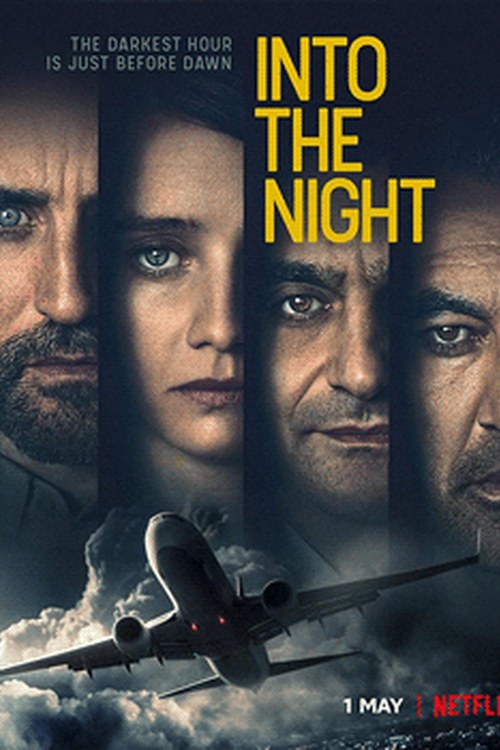
Into the Night · Season 1 · Episode 1 · 1 May 2020
S1E1 The Hijacking
A tense opener where missing money turns campaign strategy into moral triage, even when key character beats need more room.
THE MOMENT The first time the plane banks and turns westward, with the cabin just beginning to understand what they are running from.
The premiere establishes the premise with commendable economy: a soldier forces the pilot to turn the plane around before dawn, and within thirty minutes the show has explained why and set its multilingual ensemble in motion. The genre compact is clear and tightly honoured.
Full episode analysis below. Spoiler-light verdict above.
Updated
The debate begins like a ritual. A host says, "Good evening. Welcome to the 2nd round debate," and the room behaves as if politics can still be contained by format. Then Francis Laugier asks for numbers on Auzanet's job cuts, and the hour tightens. The scandal has entered before anyone names it. The warning does the real hijacking: the campaign loses control of its own narrative, and every later choice carries a moral invoice.
BollyAI's read: "The Hijacking" works best as a pressure episode about political survival. Its sharpest idea is simple. Once money goes missing, every sentence becomes evidence.
The Debate Is a Trap With Microphones
The episode opens on calculation. Francis and Wendy discuss playing double or nothing as the debate nears, a clean first move because it frames politics as gambling before the hour reframes it as liability. Francis wants control over the scandal's public shape. He presses, withholds, and searches for the version of events that can survive cameras, opponents, and the fraud squad.
That makes the debate more than a campaign set-piece. The host's formal welcome gives the evening a public clock. Auzanet is asked about state of mind. Francis demands numbers on job cuts. The surface issue is employment, but the episode keeps the real pressure elsewhere. The debate is the polished room. The scandal is the leak under the floor.
The strongest craft choice is density. The dialogue-heavy crisis pivots make the episode feel like people trying to speak faster than consequences can arrive. The pauses around the early transition points also matter. They give the hour a stop-start rhythm, as if the campaign machine keeps jamming, then restarting with worse information.
Francis works because fear stays visible. He wants the case made, and he wants silence around the parts that can hurt him. That contradiction gives the episode its engine. He is fighting to own the story while the facts keep moving without his permission.
The debate scenes also establish the episode's central language: numbers. Job cuts, late payments, missing funds, electoral margins. Everyone speaks in figures because figures sound controllable. The hour keeps proving otherwise.
The Fraud Squad Enters Before the Moral Argument Does the warning lands: an arrest is imminent, and the fraud squad is about to arrest someone. The scandal stops being a messaging problem. Legal exposure walks in, and the hour becomes brisk, tense, and usefully narrow. Nobody has the luxury of abstract outrage once the investigation is close enough to touch.
The following cash sequence is the episode's cleanest stretch. The late payments, the major shortfall, and the decision to find cash make the crisis practical. That practicality matters. The hour avoids speechifying about corruption because it can show a group moving from denial to arithmetic. Money is missing. Explanations are failing. Someone has to become responsible.
The line "What don't you understand?" cuts because it arrives as a shove, not decoration. The question forces the moral and political confrontation into the same frame. Understanding means accepting what the facts now require. It means admitting that the campaign's public certainty has become private panic.
The weakness is the thin early shading outside Francis and Joel Domfront. Wendy is present in the strategy space, but the beat-map gives her less interior pressure than Francis gets. She helps move the crisis, yet the episode rarely lets the crisis move through her. The result is a strong crisis machine with a few human gears still underwritten. The plot moves. Some people inside it need sharper edges.
Still, the fraud squad's arrival gives the opener a useful discipline. The episode does not sprawl into campaign atmosphere for its own sake. It tracks pressure from debate stage to back room, from public performance to legal danger. That compression keeps the hour alive.
The Treasurer Becomes a Firebreak
The proposal to sacrifice the Treasurer is the hour's most openly cynical beat, and it lands because the episode has already built the logic that leads there. First, keep the debate under control. Then, find cash. Then, when the facts threaten the party and election, isolate the damage. The Treasurer becomes a firebreak, a person turned into a strategy.
This is where "The Hijacking" earns its title in craft terms, even without leaning on spectacle. The campaign is hijacked by the consequences of its own story. The people in the room keep trying to decide what the scandal means, but the scandal's structure decides for them. Every practical solution exposes a value system. Protect the party. Protect the election. Protect the operation from incrimination. The order matters, and the episode knows it.
The central contradiction is blunt: the operation needs to maintain that not a single euro is missing, then has to face the admission that missing money exists. That is good political drama because it turns a slogan into a trap. Once a side has spoken in absolutes, even a small breach becomes catastrophic.
The sacrifice beat still needs more air. The idea is strong, but the episode moves quickly from shortfall to scapegoat. A little more space around the Treasurer's function, culpability, or disposability would make the choice hit harder. As mapped, the move is clear. It lacks the sting it could have if the Treasurer felt less like a role and more like a person being fed to the fire.
The scene works anyway because it sharpens the show's view of political loyalty. Loyalty here is conditional. It lasts until the risk becomes contagious.
Joel Domfront Gives the Hour Its Knife
The confrontation gives the episode its nastiest turn: Joel Domfront was the snitch, and the group has no proof. That combination is smart. A snitch with proof is a tactical problem. A snitch without proof is a moral mess, because the accused can be useful, vulnerable, and disposable in the same breath.
Joel's contradiction is the episode's most charged character note. He wants to avoid implication while giving hints that draw attention. That is a dangerous rhythm for a political thriller. He is trying to point without being seen pointing. The hour later names him as the snitch, then places his death at the centre of a funeral speech. The movement from whispered suspicion to public eulogy is harsh, and the episode understands the cruelty of that turn.
The reframing line gives the scandal a human motive: "He stole 30,000 to help the workers during the strike." That sentence does a lot of work. It gives the number. It gives the action. It gives the justification. It complicates the earlier effort to treat the missing money as a legal or electoral inconvenience.
Joel's motive also reopens the episode's political wound. The money is not abstract. It connects back to workers, a strike, and a choice made under pressure. That does not erase the theft, but it changes the texture of the scandal. The campaign wants clean blame. Joel's reason makes blame harder to package.
The funeral speech where Joel's death is framed as opening the speaker's eyes, gives the hour a sombre final shape. It also rushes past questions the hour has planted. How did the investigation and raid connect back to Joel? What evidence broke the claim that no euro was missing? Can the candidates move quickly enough to contain the fallout? Those questions are useful hooks, but the Joel turn would cut deeper if the hour let the confrontation breathe before the funeral reframed him.
The Verdict
"The Hijacking" is a solid, tense opener built on dialogue pressure, fiscal panic, and the ugly mechanics of political containment. Its best scenes understand that a scandal rarely explodes all at once. It narrows options, turns colleagues into liabilities, and makes every denial sound like future evidence. Francis gives the hour a clear centre, while Joel supplies the late wound.
The episode also shows its seams. Wendy and the Treasurer need more definition, and the Joel pivot moves faster than its emotional weight can fully support. Even so, the structure is clean: debate, warning, shortfall, sacrifice, exposure, funeral. As a season opener, it plants legal danger, electoral backlash, and a damaged public story with enough precision to carry the next episode. BollyAI's score: 7.2 out of 10.