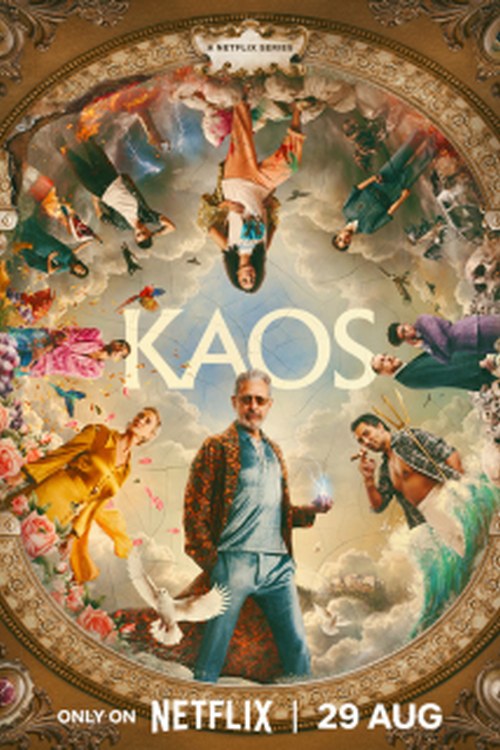
KAOS · Season 1 · Episode 1 · 29 August 2024
S1E1 Episode 1
A busy, biting premiere turns divine order into bureaucracy, then lets one prophecy line start breaking the machine.
THE MOMENT Zeus examines his reflection for the first wrinkle that will signal his doom - a small, comic moment that establishes the season's entire emotional key.
The premiere establishes KAOS's central joke immediately: the gods are petty, neurotic, and more concerned with maintaining their status than with justice or wisdom. Jeff Goldblum's Zeus is already frightened in the opening scenes, checking his face for wrinkles that would signal the prophecy's arrival. The tonal balance between satire, genuine mythology reverence, and dark comedy is set here.
Full episode analysis below. Spoiler-light verdict above.
Updated
Prometheus begins in chains and tells the story like a man who has already placed the knife under the table. The episode refuses to treat imprisonment as silence. From there, the hour cuts to Eurydice, who does not yet understand her part in Zeus's downfall, and to Olympia Day, where a public announcement casually places “the annual human sacrifice” beside ceremony. That is the premiere's trick: it makes divine power look official, repeated, almost bored. Then one line appears, and the machine starts coughing.
BollyAI's read: the premiere works because it treats prophecy as a systems failure. Gods, rituals, monuments, prayers, family order. Everything looks permanent until the episode shows how much maintenance permanence needs.
A Kingdom Held Together by Announcements
The smartest early move is the Olympia Day framing. The hour opens with procedure. Announcements roll out, ceremony takes shape, and “First up, the annual human sacrifice” lands with a nasty little shrug. That phrasing matters. No scandal frames the sacrifice. It sits on the schedule.
That casualness gives the episode its bite. The gods' authority here comes through civic routine as much as thunder. People have learned the calendar. Ritual has become admin. A human sacrifice can be formatted like a parade item, which says more about this world than a lecture on divine cruelty could.
The premiere moves quickly between banter, ceremony, and prophecy business, and that pace suits the premise. It lets horror and comedy sit close without making either apologize. The gods are embedded into public life, and the episode's comedy comes from how normal the arrangement has become.
That also gives the blasphemy its charge. When Zeus is shown the desecrated monument reading “Fuck the gods,” the act cuts through the pageantry because it is crude, public, and impossible to ritualise away. A polished empire can absorb dissent. An insult that ugly makes the polish look thin.
Zeus Mistakes Control for Safety
Zeus enters as a ruler trying to turn panic into posture. He wants to believe the prophecy cannot touch him, yet every new beat makes that belief look like a coping strategy. His line, “The prophecy cannot come to pass. Prophecies are for humans,” sounds like an order he is giving reality.
That is strong writing because it makes Zeus powerful and frayed. The desecrated monument rattles him. The prophecy unsettles him. He tries to shrink threat into category. Humans get prophecies. Gods sit above them. Therefore the danger must be administrative error rather than existential crisis.
The episode is at its best when it watches him perform kingship under pressure. He reframes. He denies. He maintains the tone of a man who cannot be contradicted, while the story builds a structure where contradiction is the point. The prophecy reads, “A line appears, the order wanes,” and the wording is beautifully economical. A line is small. Order is huge. The fear comes from the gap between them.
There is a risk here. The premiere pushes a lot of mythology, status, and prophecy mechanics into the opening hour. The dialogue density keeps the plot moving, but it sometimes leaves less room for dread to gather. Still, Zeus gives that density a centre. His panic has a shape.
Riddy Wants an Exit, Not a Destiny
Riddy gives the episode its human counterweight. The divine plot speaks in prophecies, but her need is immediate and painfully plain: she wants to leave her husband, resist the day, and refuse the role being built around her. Her line to her mother, “Please, can you just tell me what to do?” is one of the hour's cleanest emotional beats because it punctures the swagger of defiance.
That tension defines her. Riddy says she defies the gods, and the episode lets that mean something. She also wants instructions. Permission. Direction. A path. In a world where gods turn human lives into ritual material, choice arrives as confusion before it can become action.
The long silence around her section matters for that reason. After so much talking, the episode gives transition and ritual space to Riddy's decision-making. The quiet does not make her passive. It makes the trap visible. Everyone around her seems to know what the day requires. Riddy is the one trying to make the day answer to her instead.
Her offering to Hades as a mortal charm or subject in the sacrifice ritual sharpens the cruelty. She is a person with a private crisis, but the system treats her as material. The premiere's best character work comes from placing her emotional exit plan against a cosmic process that has already filed the paperwork.
Prometheus Makes the Prison Feel Like a Strategy
Prometheus is the hour's slyest mechanism. He opens as a prisoner, but the writing gives his captivity purpose. His position creates a framing threat: if he is telling the story, he is also arranging how the story is understood.
The key contradiction is that he wants to influence Zeus's outcome by manipulating the meaning of the prophecy. He lies to Zeus that the prophecy can come to pass and that Zeus can be destroyed. That detail gives the premiere a pleasingly crooked spine. Information has intent here. Interpretation is a weapon.
This is where the hour pushes past stylish myth remix. Zeus thinks prophecy is beneath him. Prometheus understands that even a god can be moved by a sentence if the sentence finds the right insecurity. The episode turns language into leverage: a line appears, a phrase repeats, a forbidden possibility becomes thinkable.
The final explanation that Zeus can be destroyed because he “used to be one of you” opens the biggest door of the episode. It destabilises the mythology. Divine authority has a past, and a past means origin and weakness. The hour has spent its runtime presenting Olympus as an established order. Prometheus's angle suggests order is history with better branding.
Hera's Comfort Sounds Like Ownership
Hera enters through the tacita, with the phrasing “May the goddess Hera cradle you in your mortal pain.” It is a soft sentence with a hard function. Comfort, in this world, is another arm of authority. Even pain gets routed through divine language.
That is a smart tonal choice because the episode allows godly gestures to look tender while still serving control. Hera's presence expands the show's idea of power beyond Zeus's visible anxiety. Zeus reacts to threats like a king afraid of losing the room. Hera's ritual language suggests a quieter system, one that absorbs suffering by naming it and blessing it.
The premiere could have used more clean air around this material. With so many threads introduced, Hera's machinery is sketched rather than fully felt in the opening hour. Still, the tacita beat earns its place because it deepens the world. The gods are worshipped at temples, feared during sacrifice, and present in the phrases people use to survive pain.
That makes Riddy's resistance feel practical rather than symbolic. To say “fuck them” in this world is an attempt to speak without borrowed divine grammar.
The Verdict
“Episode 1” is a confident, busy premiere with a clear idea: divine order works best when it looks routine. One forbidden line makes everyone check the foundations. The hour's best beats are plain and brutal: Prometheus in captivity, Olympia Day treating sacrifice as programming, Zeus insisting prophecy is a human problem, Riddy trying to turn defiance into action. The weakness is compression. The episode sometimes explains when it could let fear sit in the room. Even so, the craft is clear. It plants prophecy, rebellion, ritual, and vulnerability while keeping its central joke sharp. The gods run the world like permanence is a given, and the first crack has already reached Zeus.