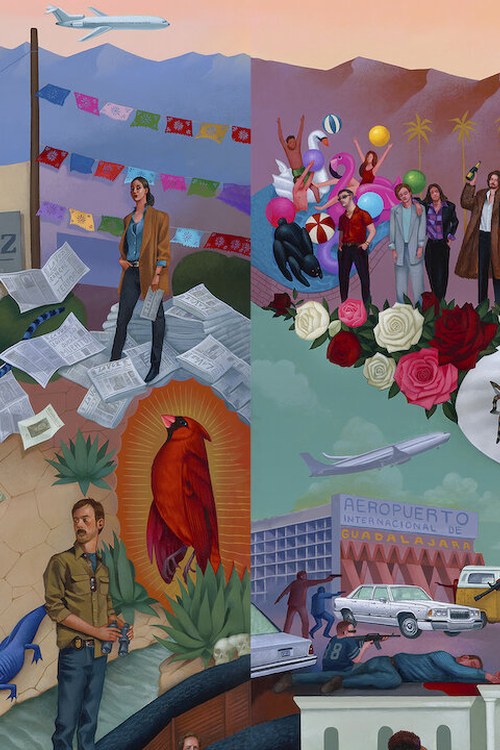
Narcos: Mexico · Season 1 · Episode 1 · 16 November 2018
S1E1 La Ultima Frontera
A controlled premiere where badges, fields, and bargains matter before the chase even begins.
THE MOMENT Felix's introductory meeting with a Colombian contact - the moment the cartel calculus shifts from local to international.
The premiere sets the table with economy and style, establishing Felix Gallardo as a pragmatist rather than a thug - and making the DEA's task feel genuinely impossible.
Full episode analysis below. Spoiler-light verdict above.
Updated
A narrator opens with a warning: this story has no happy ending. Then the episode refuses to sprint toward it. It goes back to the fields, the uniforms, the bargain, the office introduction. “But I can tell you how it began,” the narrator says, and the line becomes the hour’s operating manual. This premiere is built around competing claims of authority: the army burns, the police negotiate, the traffickers relocate, and the DEA looks for a way in. BollyAI's read: “La Ultima Frontera” works because it treats the drug war as a system before it treats it as a chase.
The War Begins as Paperwork With Guns
The first sharp move is the narration’s refusal to sell victory. The opening promise of a story without a happy ending drains the usual pilot fantasy from the frame. The episode names Kiki Camarena early as the relevant person in this drug war story, but it does not hand him the hour. That restraint matters. Kiki is entering a machine already in motion.
Operation Condor gives that machine its first shape. The narration calls it an invasion and search-destroy mission in Sinaloa, and the bluntness is the point. “They called it Operation Condor,” the narrator says, and the title lands like a stamp on a file before the violence hits the ground. Fields burn. Men are captured. Information is extracted. The war is public policy with smoke on it.
That structure gives the premiere more force than a simple introduction. It starts with a frame, then keeps testing who gets to control it. The army has its operation. The police have their badges. The growers have their fields. Power here depends less on who has a gun in one scene than on who can make everyone else accept a version of reality.
Félix Gallardo Wants Order, Then Uses Pressure
Miguel Ángel Félix Gallardo enters under the sign of authority, identifying himself as Sinaloa State Police while addressing the operation. That detail is the character in miniature. He is not introduced as chaos. He wants control, especially around Rafa Quintero’s extraction during Operation Condor. The hour gives him a sharper contradiction than a standard crime-boss pose: he wants to avoid unnecessary escalation, but his tools are bargain, intimidation, and pressure.
The captured man who points officers toward the Tameapa fields gives Félix Gallardo the kind of information this world runs on. The fields that have not been burned become the prize. That beat is clean because it turns geography into leverage. A field is money, proof, exposure, and survival. Once Rafa Quintero is identified and detained, Félix Gallardo’s demand for field locations shows how quickly control becomes coercion.
The writing wisely avoids making his control look smooth. Félix Gallardo is trying to manage a situation already destabilized by the army’s operation. He behaves like a man who understands systems, but the system answers him with fire, detention, and frightened informants. The performance of order is the mask. The episode keeps showing the hand tightening underneath it.
Guadalajara Is Sold Like a Lifeboat
The relocation proposal gives the premiere its best business scene. Around the thirty-seven-minute mark, Don Neto faces a counterpart who proposes moving the growing operation to Guadalajara in exchange for police protection. The pitch has logic. Sinaloa is being scorched by Operation Condor. Guadalajara offers cover, protection, and a new arrangement. The hour shifts from armed pressure to negotiated power without losing its pulse.
The profit-split escalation gives the scene its bite. Each offer narrows the space between partnership and domination. Don Neto wants terms. The other side wants surrender dressed as structure. By the time the final demand arrives, “You get nothing and get out of my fucking town,” the negotiation has stopped pretending. The scene is no longer about arithmetic. It is about who gets to decide the future.
That ultimatum plants the episode’s strongest open loop. The relocation can become a solution, or it can trigger more violence. The show does not need to answer yet because the premise is already loaded: if Sinaloa is burning and Guadalajara is protected, the move is tempting. If protection comes with humiliation, the move is combustible. The numbers are the least important thing being negotiated.
Kiki Arrives After the Rules Are Already Written
Kiki’s arrival in Guadalajara comes late enough to make a point. he introduces himself while seeking Jaime Kuykendall, and the episode positions him as part of an operational handoff rather than the master key to the story. That is a strong choice for a premiere built around a famous drug-war frame. Kiki is important, but the world does not begin when he enters the room.
His internal map is practical. He wants intelligence work, local relationships with Mex-Feds, informant access, and credibility. The “data-gathering assignment” introduction to a case officer gives him a grounded professional lane. Cowboy mythology can wait. For now, he is trying to learn the terrain, build channels, and find usable information without getting swallowed by the machinery he is studying.
The DEA gag when one figure claims “I'm DEA” and gets the answer “Yeah? And I'm fucking Olivia Newton-John,” gives the episode a useful flash of acid. It punctures institutional self-importance without breaking tone. In this world, a badge does not automatically create access. It creates a claim. Kiki’s problem is that everyone has a claim already: the army, the police, the growers, the men selling protection. His mission begins in a crowded room.
The Premiere Cuts Clean, Then Runs Hot
The episode’s dialogue density could have turned the hour into a briefing packet. Instead, the structure keeps resetting pressure: narration into operation, operation into interrogation, interrogation into relocation pitch, pitch into DEA introduction. The quiet pockets matter. Without them, the escalation would blur. With them, each new power play gets its own temperature.
Where “La Ultima Frontera” is less elegant is in how much architecture it has to install. The narrator’s frame, Kiki’s positioning, Operation Condor, Félix Gallardo’s contradiction, Don Neto’s negotiation, the Guadalajara open loop, and the intelligence mission all arrive in one premiere. The episode handles the load, but the seams show. Some beats function as signposts more than scenes with full dramatic release.
Still, the craft logic holds. The hour does not chase shock for its own sake. It builds a board. By the end, the essential question is not simply what Kiki will do in Guadalajara. It is whether intelligence work can matter in a place where every institution has already been priced, pressured, or burned.
The Verdict
“La Ultima Frontera” is a controlled premiere that understands the value of delayed heroism. Its best choice is structural: Kiki Camarena matters, but the episode makes him arrive into history rather than stand above it. Operation Condor gives the hour scale, Félix Gallardo gives it contradiction, and Don Neto’s negotiation gives it a clean dramatic hinge. The drawback is density. The premiere carries so much setup that a few scenes feel like necessary infrastructure rather than fully released drama.
BollyAI’s score: 8.2/10. As a season opener, it plants three durable engines: the Guadalajara move, Kiki’s intelligence mission, and the drug war origin story promised by the narrator. The episode earns its slot by making the opening hour feel crowded, volatile, and already compromised.