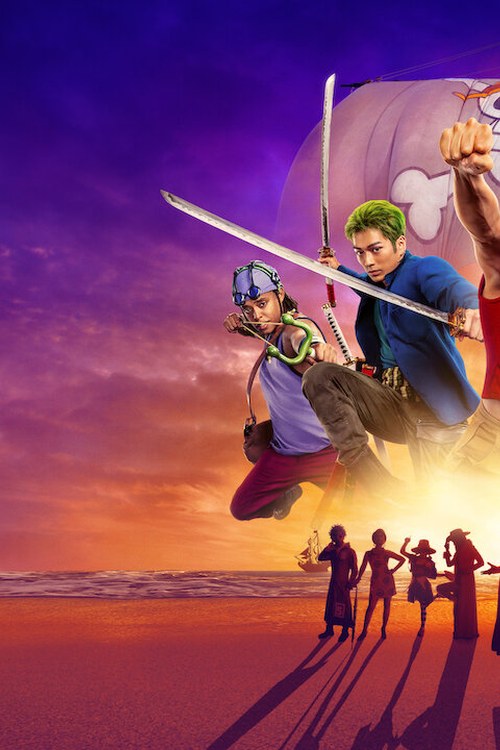
One Piece (Live-Action) · Season 1 · Episode 8 · 31 August 2023
S1E8 Worst in the East
S01E08 makes the finale about belonging under pressure, using clear action and crew choices to turn origin energy into earned momentum.
The episode opens on a simple idea dressed as a threat. Somebody has decided the world is safer when Luffy is contained, not understood. So the hour tightens the net around the people who chose him, and it does it with speed that feels earned. The camera lingers on the costs of l
Full episode analysis below. Spoiler-light verdict above.
Updated
COLD OPEN
The episode opens on a simple idea dressed as a threat. Somebody has decided the world is safer when Luffy is contained, not understood. So the hour tightens the net around the people who chose him, and it does it with speed that feels earned. The camera lingers on the costs of loyalty, not the comedy of it. Then the episode pivots from “survive” to “claim,” like a pirate captain waking up from a dare.
The Betrayal Doesn’t Work Twice
Season 1 has been building toward one core promise: Luffy’s crew is not just a group of friends, it is a system for choosing each other. S01E08 cashes that promise by making the final conflict about belonging, not brute power. The episode’s strongest move is how it treats the climax as a test of relationships already formed, instead of a reset button for new gimmicks.
The Crew Becomes the Weapon
Monkey D. Luffy spends most of the season turning danger into motion, but in S01E08 the show finally makes that motion feel structural. Luffy is still Luffy, still loud in his certainty, still allergic to hierarchy, but the story stops framing his personality as luck. It frames it as leadership style: the way he keeps dragging people forward until they choose to stay.
That matters because the live-action adaptation has been fighting a familiar genre adaptation problem. In weaker versions of this project, the cast can feel like a list of references. Here, the episode makes the crew feel like a decision that has consequences. Roronoa Zoro and Nami are not simply “cool” or “useful.” They are part of the hour’s moral math. When pressure rises, the writing asks a sharper question than “can they win?” It asks whether the people who follow Luffy actually believe the same thing he believes, or whether they are only tolerating him until a better option appears.
The episode uses that crew logic in the way it stages conflict. Threats come less as cinematic invaders and more as interruptions to the relationships already in motion. You can feel the show testing whether the ensemble can carry a finale without leaning on spectacle to do the emotional work.
The Villain Playbook Gets Exposed
The show’s early episodes set up the idea that Baroque Works is not just a criminal organization. It is a machine for turning people into tools. That framing pays off in the final stretch because S01E08 treats the opposition as an ideology, not merely an obstacle.
Buggy has been a recurring pressure point for the season’s tone, a reminder that comedy can coexist with danger. In the finale, the episode leans into the idea that comedic villains are often just honest opportunists, and opportunism collapses under a crew that refuses to be property. The writing makes it clear that the antagonists want containment, while the protagonists want expansion. That sounds simple until the hour forces you to watch what containment actually looks like: not just restraint, but attempts to rewrite someone else’s fate in advance.
Even when the episode leans into classic pirate-audience rhythms, it avoids the most common adaptation trap, which is flattening villain motivations into “they’re evil because they can.” Instead, the opposition acts like a system. The climax feels earned because it attacks the system’s assumption that characters are isolated units.
Action With a Pulse, Not Just Heat
There is a difference between “big finale action” and “action that carries the theme.” S01E08 chooses the second. The fights and set-pieces are directed with an eye for clarity, not only velocity. The episode makes space for reactions and for the quiet seconds after impact, which is where the show has always been its most human.
Usopp has been a character defined by fear and performance. In the season’s final hour, the script uses that tension properly. His emotional beats are not decoration. They are leverage. When Usopp’s confidence wobbles, it stops being a running joke and becomes a dramatic hinge. The show is careful about when it lets him be funny and when it lets him be scared. That precision is what keeps the live-action from turning into a series of set-piece cosplay moments.
Sanji also gets positioned as more than a swagger signature. In an adaptation this large, it is easy to rush the character into “cool moves, no psychology.” S01E08 resists that. It gives him the kind of decision-making that fits a family-oriented adventure tone: not moral speeches, but choices that show priorities. The emotional rhythm of the action improves because the characters are allowed to matter while they move.
If there is a flaw, it is that some momentum builds more from necessity than suspense. The hour has the energy of a sprint, and sprint finales sometimes skim the emotional breath between beats. When the episode accelerates, a few dramatic turns feel slightly pre-selected, as if the story is too aware of its destination to fully enjoy the route.
Luffy’s Freedom Gets a Cost
The season has repeatedly aligned Luffy’s freedom with joy, and S01E08 does something smarter. It ties freedom to consequence. Luffy’s charisma has always been the engine, but this finale insists that charisma does not erase risk. It repackages risk into something the crew can share.
The episode’s clearest argument is that Luffy does not just want to escape danger. He wants to belong to a future the danger cannot control. That is why the finale’s emotional center is loyalty under pressure. When the hour turns from survival to claim, the show makes sure the claim has fingerprints: the crew has paid for it in discomfort, in fear, in the willingness to keep showing up.
Dr. Kureha and Coby are also used as thematic anchors for what the crew’s growth means beyond Luffy’s personal myth. They keep the story grounded in “the world changes because people choose,” not because fate decided to be generous. That is family-adventure storytelling at its best: big feelings, but rooted in human decisions.
The episode closes by reinforcing the season’s strongest achievement. It does not feel like fan service pasted over a plot. It feels like character momentum turned into a promise. For a genre that has suffered so many adaptation failures, the finale’s most persuasive victory is that it behaves like an origin story that understands its own stakes.
The Verdict
BollyAI’s read: S01E08 works because it treats the finale as a relationship test, not a spectacle problem. The episode cashes in the season’s core craft win, the ensemble chemistry that makes danger personal. It also keeps the action readable, lets fear play alongside comedy, and turns Luffy’s “freedom” into something with cost and commitment. If the hour feels slightly too direct at moments, it is a small trade for clarity and momentum, and the episode still earns its emotional landing.
Season arc note: this episode completes the season’s transformation of Luffy from a charming disruption into the center of a crew-based mission, while setting the next phase of the Grand Line story as an escalation of consequences.