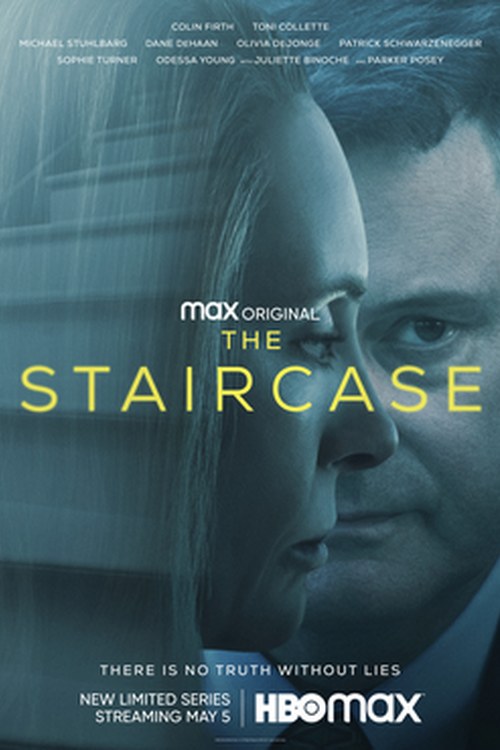
The Staircase · Season 1 · Episode 1 · 5 May 2022
S1E1 Zoom
A controlled opener turns one emergency call into a battle over who owns the first story.
THE MOMENT The opening shot of Peterson being filmed being filmed - a visual joke that is also a thesis statement for the entire series.
The premiere opens with the French documentary crew already embedded - immediately complicating any stable vantage point. Campos signals from the first scene that representation itself is the subject.
Full episode analysis below. Spoiler-light verdict above.
Updated
Durham 911 is called from 1810 Cedar Street, and the first story arrives fast: a wife is not breathing, and the cause has already been named. “She fell down the stairs.” The sentence is clean enough to be useful and thin enough to become dangerous. Within minutes, Kathleen is dead, the family has been told, and the house no longer belongs to the people inside it. "Zoom" works because it understands that the first version of a tragedy is never neutral. It becomes evidence, shield, weapon, and trap.
The First Story Gets There Before the Law
The episode opens oddly, with a man talking about wanting products made by their own workers in their own factories. Then the hour cuts into the emergency call, and that first line gains a quiet charge. "Zoom" is obsessed with ownership: who made the story, who controls it, who gets to package it for everyone else.
The 911 call is the episode's cleanest piece of writing because it compresses the season engine into under a minute. The caller needs help. The caller gives a cause. The caller asks them to hurry. The episode does not underline the problem because the claimed accident is already doing too much work.
That is the hook. The staircase is introduced as an object of explanation before it becomes an object of investigation. A fall is simple. A death at the bottom of stairs is frightening but legible. A house full of people can repeat it. Emergency responders can react to it. Family members can cling to it. Then the hour starts pulling that sentence through procedure, and the clean line begins to fray.
The immediate crisis window is dialogue-heavy, and that matters. People are trying to make reality hold still by speaking it into shape. The episode's best early instinct is to let urgency become structure. It does not need a grand speech. A call, an address, a body, a fall. That is enough rope.
It also keeps the audience in the same unstable position as everyone in the house. The first account arrives with speed, emotion, and apparent simplicity. The episode refuses to treat those qualities as proof. Speed can look like truth because it leaves no time for resistance. "Zoom" understands how a sentence can harden before anyone has checked whether it can hold.
A House Stops Being a Home
By, the house is declared a crime scene, and the episode makes that pivot count. A home can absorb grief. A crime scene cannot. It has rules, borders, permission, and authority. Everyone must stay until further notice, which turns private shock into supervised waiting.
This is where Michael Peterson becomes the hour's most unstable object. His contradiction is built into the situation rather than played as one explosive outburst. He wants control over what is known and how much is known. He needs a coherent, non-criminal explanation. He has an account: he came in and found Kathleen. The episode places that account inside a room already seized by another language.
The arrival of Art Holland with a warrant is a clean procedural escalation. He does not need theatrical dominance. His authority changes the physics of the house. Search replaces comfort. Evidence replaces furniture. The staircase no longer exists mainly as the site of a fall in the family account. It is a surface to be read by officials.
That shift is the episode's best argument. "Zoom" does not ask whether grief is sincere. It asks what sincerity is worth once forensics, warrants, and photographs enter the room. In this opening hour, sincerity loses practical value when the state begins assembling its own version.
The staging helps. People remain in rooms that used to mean ordinary domestic life, but the frame keeps reminding us that ordinary use has ended. The house has been reclassified. So has everyone in it. Family members become witnesses, possible sources, potential liabilities. The episode gets tension from that bureaucratic transformation. Nobody has to shout for the scene to turn hostile.
Michael's need for control also reads more sharply because the episode refuses to flatten him into pure panic. He is bereaved, frightened, strategic, and exposed. The hour does not resolve those impulses into a single answer. It lets them crowd the frame. That uncertainty is the drama.
Cake at the Funeral Home, Blood in the Frame
The strangest beat in the middle may be the instruction to get a cake for Margaret from the funeral home. On paper, it sounds absurd. In the hour's design, it is the kind of absurdity grief produces when nobody has the luxury of behaving symbolically. A cake still has to be handled. A family still has to be managed. A dead woman is now the center of a case, but the living keep needing small, practical things.
The beat also exposes one of the episode's limitations. The sharpest sections live in the immediate emergency and the later legal escalation, and the tone notes bear that out: the dialogue density spikes in those zones. The middle has stretches of silence, including a long quiet run to. Silence can be a weapon. Here, the hour occasionally lets the procedural machinery pause without replacing it with a sharper emotional collision.
Still, the cake detail earns its place because it keeps the family from turning into a row of shocked faces. Bill, in particular, is caught in a brutal little contradiction. He wants the family represented and quiet, but he also becomes the person carrying the simplest truth: Kathleen is dead. That is not strategy. That is damage control after the damage has already won.
The episode is strongest when it lets logistics reveal character. Nobody gets to grieve in a clean line. They are interrupted by instructions, warrants, phone calls, and the need to say the unsayable to someone who is not ready to hear it.
That approach keeps melodrama out of the room, sometimes to a fault. The restraint suits the series' procedural interest, but the hour can feel too careful when it lingers on waiting without adding pressure. Grief in "Zoom" is rarely cathartic. It is administrative. Forms must be signed. Calls must be made. People must be told where to stand. That is an effective lens, but the episode gets more power when those tasks collide with fear and suspicion rather than simply filling time.
The Law Finds Its Ending
The final stretch tightens because Jim Hardin gives the hour a destination. He wants to formally present charges against Michael Peterson, and the episode lets that legal movement gather force until the vote leads toward a first-degree murder indictment. The family has spent the hour inside one version of events. The law arrives with another.
The key late turn is the claim that Kathleen was bludgeoned, with photos to be shared. That is a violent narrative correction. It does more than dispute the fall. It replaces accident with assault. The episode also plants a harder forensic question for later: what caused the fatal injuries, especially with the open issue of no skull fractures described later? That question gives the ending its bite. The case is getting more specific and more confusing at once.
The legal escalation works because it mirrors the 911 call. Early on, the story is spoken quickly in crisis. Late in the hour, the counter-story is spoken formally in procedure. One version says fall. The other says bludgeoning and possible strangulation. Between them sits Michael, trying to maintain a non-criminal frame while the official account grows teeth.
"Zoom" is a title that fits the hour's method. The episode keeps tightening the image. First the whole house, then the staircase, then the body, then the photos, then the vote. Each zoom removes one layer of family control.
That narrowing gives the opener a satisfying shape even when the middle slackens. The episode begins with a man supplying an answer and ends with institutions preparing to make their answer official. The case has moved from emergency response to accusation. The house has moved from private space to evidence field. Michael has moved from grieving husband to target. "Zoom" makes those transitions feel procedural rather than sudden, which is why the indictment lands without needing a final flourish.
The Verdict
"Zoom" is a strong opener because it makes narrative control the case before the case fully becomes legal. The episode takes one emergency call and tracks how its first explanation is challenged by search, forensic framing, and indictment. Its weakness is a middle stretch that leans on silence and logistics without always making them cut as sharply as the opening and closing runs. The spine is firm: a family tries to live inside the word accident while the law begins building the word murder. As a season launch, it plants the right open loops: the fall, the injuries, the shifting official account, and Michael's need to keep the first story intact.