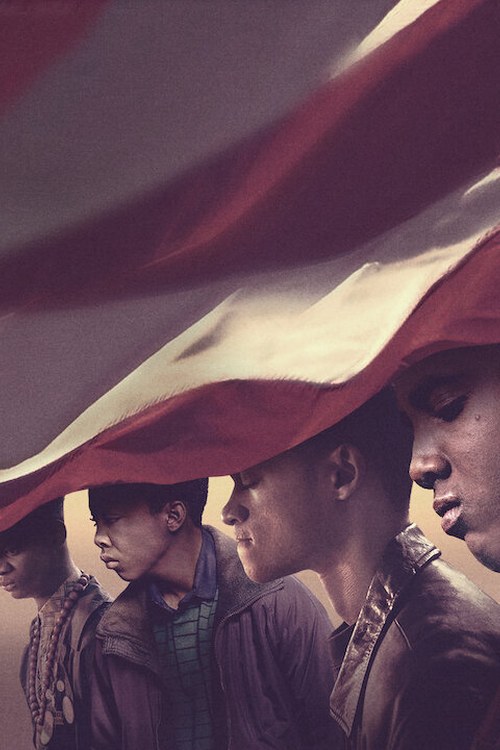
When They See Us · Season 1 · Episode 1 · 31 May 2019
S1E1 Part 1
A precise, punishing opener that turns teenage noise into official language, then shows boys trapped inside the sentence.
THE MOMENT The moment a detective tells a teenager his friend already confessed - and the lie starts to cascade through the room.
The opening episode reconstructs the night of April 19, 1989, and the interrogations that followed. DuVernay refuses to reproduce the tabloid frame - the camera stays with the boys, not the prosecution. The coercion of children is shown methodically, without score-swelling drama, which makes it more disturbing than spectacle would.
Full episode analysis below. Spoiler-light verdict above.
Updated
Tron starts with French fries. No courtroom or headline prelude. Just boys talking about traitors, watches, and whether anyone will show up at Sharene's party. Then the night snaps. A fight follows a claim about white dudes jumping someone in the Bronx. A police call turns boys in a park into a "roving band" assaulting people near Central Park. After a rape is reported, a detective orders the kids woken up for questioning. The episode's argument is already in place: ordinary noise can become an official story with terrifying speed, and a child has little chance once that story starts writing him.
The Night Begins Small, Which Is the Point
The sharpest choice in "Part 1" is that it does not begin with the machinery. It begins with looseness. Tron jokes that there are no French fries for traitors. The group worries about whether watches arriving will come to Sharene's party. The details are small, even silly, and that scale matters. The episode shows a social world before it is translated into charges, movement patterns, timelines, and interrogation material.
That first movement has a casual teenage pulse. People drift, talk, react, and carry private concerns that have nothing to do with the crime that will define the hour. Then a fight escalates after someone says white dudes jumped him in the Bronx. The event matters less as a clean cause than as a turn. Suddenly motion has meaning because authority arrives to name it.
The police call performs the first transformation. A group becomes a "roving band" near Central Park. The language tightens. The kids may still be confused, scattered, or scared, but the system now has a category. The episode's first cruelty is grammatical. Once the night enters police phrasing, every boy inside it has to fight a sentence already built against him.
The Machine Does Not Need to Shout
The episode's police material hits hardest because it is procedural rather than operatic. A parent learns a boy faces unlawful assembly and next shift processing. That phrase has no villain twirl in it. It is bland, routine, almost sleepy. Then the rape investigation enters, and the rhythm changes. a detective orders, "Wake these kids up and start getting some information." The command is chilling because it is practical. The children are approached as sources before they are treated as children in distress.
Dialogue density spikes during the police and interrogation segments, and that craft choice carries the hour. Earlier conversations have air around them. In the station, questions, commands, and logistics crowd the frame. "Get the clothes from last night" links detention to evidence handling. Names, garments, whereabouts, and sequence become the new currency. The episode does not explain pressure with speeches. It lets pressure become sound.
That is why the pacing works. The first act wanders because the boys are wandering. The station scenes compress because the system compresses. The writing earns dread by narrowing the boys' options one instruction at a time. A weaker episode would underline every injustice. This one lets routine do the damage. Paperwork becomes menace. Processing becomes plot.
A Timeline Turns Into a Trap a detective lays out Trisha Meili's phone call and jogging timeline. The detail that Trisha Meili lives on East 83rd Street anchors the case in geography and sequence. From there, the episode shifts the conflict from fact-gathering to fact-arrangement. The open loops are timeline problems: what happened between the described and events, whether discrepancies can be reconciled with assault locations, and who is responsible for false or conflicting statements.
That is strong dramatic architecture because it makes confusion feel dangerous. A timeline should clarify. Here, it threatens. Every minute that cannot be neatly accounted for becomes a space where someone can be pushed, folded, or placed. The park stops being merely a place the boys moved through and becomes a diagram into which their words can be forced.
The episode also understands that investigative certainty can be staged before it is earned. The more detailed the timeline becomes, the more vulnerable the boys look inside it. This is the hour's best craft move: chronology becomes a pressure chamber. The facts may be incomplete, but the confidence around them is already hardening.
Parents Arrive Against a Locked Door
The mother brings the hour's cleanest rupture. She demands to see her son and says, "I'm stopping this right now. Right now!" The line works because it crashes into a system already in motion. Until then, the interrogation structure has been built through commands, logistics, and information extraction. A parent enters with a different grammar: protection and refusal.
The episode plants one of its largest legal questions here without overexplaining it. What follows from interrogating minors without a guardian or lawyer present? The hour keeps the question concrete. It sits in the room with the boys. It changes the meaning of every answer given under pressure, every statement shaped before an adult can stop the process.
The limitation is that the parent material, at least in the provided beats, arrives as a sharp intervention rather than a balanced counterweight. The institutional scenes dominate, which is dramatically effective, but it means the family side sometimes functions as an alarm bell more than lived-in space. Still, that imbalance may be the point of the hour's structure. The parents are late because the system has already taken the lead. By the time a mother says she is stopping it, the story may have moved farther than her authority can reach.
Korey and Tron Become the Hour's Argument
The character contradictions give "Part 1" its human spine. Korey Wise wants to go home, yet ends up stating a story about where the group moved during the assault. Tron wants to avoid being framed for rape, yet later admits, "I lied on you" after being made to lie. The wording is the wound. They made him lie.
That distinction matters. The hour avoids a tidy confession scene or one clean moral collapse. Coercion appears as a process. Wants bend. Fear redirects speech. Survival instincts create damage that can be used against someone else. The boys do not need to understand the full legal consequences for the consequences to become real.
This is where the episode refuses easy comfort. Tron's wish to avoid implication does not protect him from becoming part of another boy's implication. Korey's wish to go home does not save him from participating in a narrative that can trap him. The hour's power comes from showing falsehood manufactured in pieces. A command here, a timeline there, a frightened child in between. One perfect lie is unnecessary. Enough broken statements will do.
The Verdict
"Part 1" is a grim, controlled opening that argues through procedure. Its strongest move is structural: it begins with casual teenage motion, then lets police language, timelines, and interrogation rhythm turn that motion into accusation. The episode can feel weighted toward process over interiority, especially when the parent intervention gets less room than the station machinery around it. But the craft is hard to shake. The terror sits in the speed of conversion, as an ordinary night becomes material for someone else's case. As a season opener, it plants the essential wounds: false statements, disputed timelines, and the legal cost of children being questioned before protection reaches them.
"Elegant, wrenching four-part reenactment of the Central Park Five saga."
Time