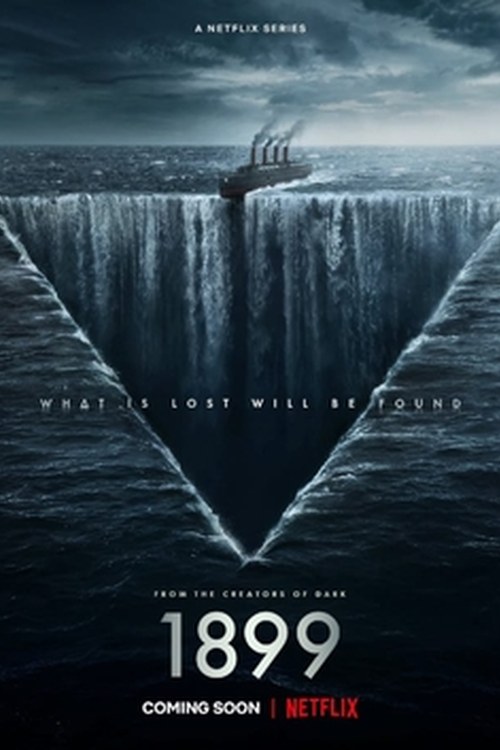
1899 · Season 1 · Episode 7 · 17 November 2022
S1E7 The Storm
A tense mechanics hour that sharpens the loop, then lets exposition crowd the terror of losing control.
The ship at last feels like it is moving toward answers, not just deeper fog. A new sequence of discoveries locks the crew into motion, but the momentum is wrong in a way the show makes you notice. People who were trying to survive are suddenly forced to reenact the same conversa
Full episode analysis below. Spoiler-light verdict above.
Updated
The warning comes early and without poetry: “We don't have much time before everyone will die again,” Unknown says. That is the hour's cleanest idea. Death has stopped being an ending. It is a schedule. Episode 7 works best when it treats the loop as a practical emergency, with people racing toward engine rooms, bridges, codes, devices and ports because the ship no longer feels like a place. It feels like a system refusing to let them leave. BollyAI's read: the episode finally names its machine, and the naming has a cost. Mystery tightens. Character breath gets thinner.
The Loop Gets a Clock
The episode opens by framing reality as something housed inside the mind, which is the kind of premise 1899 has circled since the start of its puzzle-box structure. Here, though, the language stops teasing possibility and starts behaving like instruction. The crucial early beat is time pressure: everyone will die again. That word, again, does heavy lifting. It makes survival feel temporary, action feel urgent, and grief feel procedural.
The decision to warn the crew in the engine room gives the hour its first useful shape. The characters are no longer sitting around decoding symbols for atmosphere. They are moving information through a ship before the system catches up. That matters because Episode 7 has a heavy exposition load, and movement keeps it from turning into a chalkboard.
The writing's strongest move is making repetition cruelly practical. If death can recur simulation after simulation, a warning becomes triage. Panic gets sharper when characters know too much and still cannot control the process. The downside arrives in the same package: once the rules become this explicit, the fog loses some charge. The mystery is cleaner now, but cleanliness has never been 1899's natural habitat.
Maura Becomes the Exit and the Prize
The plan that forms around Maura gives the episode its central pressure point: “We will get her out so she can end this loop once and for all.” The sentence turns her into a solution before the hour fully lets her remain a person. That is the point and the problem. Maura wants the device and the code to stop the loop, but the episode keeps pushing her agency into other people's hands as the hunt for the key intensifies.
That contradiction gives the hour a nasty pulse. Maura is treated as the one person who can end the system, yet she is boxed in by demands she cannot fully command. The antagonist figure's late demand, “I want the key,” shifts the endgame away from escape as a shared goal and toward control as ownership. The same figure claims compliance can preserve her son while declaring the crew will eventually die in the next simulation. That is coercion dressed as protection.
This is where Episode 7 finds its most interesting emotional angle. The loop is technical, but the leverage is intimate. Maura's son is pulled into the logic of access, keys and compliance, turning motherhood into a pressure point inside the machine. The hour does not need a speech to make that cold. The structure does it.
The frustration is that Maura's fear and guilt can get crowded out by the mechanics surrounding her. The episode knows she matters, but it often defines that importance through what others need from her. That makes thematic sense in a story about control. It also narrows one of the season's most important emotional channels just when the plot needs her to feel most human.
The Ship Turns Into a Control Problem
Once the reveal lands that this is a simulation, the ship's geography changes. The bridge, the engine room, the storm and the port stop being maritime pieces and become control surfaces. Ling Yi wanting to reach the bridge during the storm fits that shift neatly. Her objective is immediate and physical, but the episode keeps redirecting her toward broader loop and escape mechanics. It is smart friction. Human instinct says to get to the place that steers the ship. The hour says steering no longer lives there.
That is also why the code and override matter. When Unknown says, “There's a code, an override,” the episode gives its escape plot a handle. The danger with a line like that is obvious: mystery can become software support if the drama leans too hard into instructions. Episode 7 walks close to that edge. Dialogue density spikes around the storm and loop mechanics, with rapid imperatives and repeated explanations doing the job of momentum.
Still, the tactical beat about anchoring everyone so they go through the same port is one of the hour's cleaner ideas. It turns abstraction into action. The characters learn what the simulation is, then adapt inside it. That distinction saves the middle stretch. Exposition has a job. The job is to change what characters do next.
That is where the episode is at its most controlled. The rules do not sit in the air as lore for lore's sake. They create movement, force choices and expose who understands the system well enough to manipulate it. Even when the dialogue grows crowded, the hour keeps tying information to a physical task. Get to the engine room. Find the device. Use the code. Reach the port before the shutdown completes.
Lucien's Survival Math Runs Out
Lucien gets one of the episode's more grounded contradictions. His survival instinct is tied to shielding the situation, including medicine and vial logistics, but the shutdown sequence exposes how brittle that control is. In a story increasingly ruled by code, override and key, physical management starts to feel almost old-fashioned. Pills, vials, bodies and concealment belong to a world where the rules still respect matter.
That contrast is useful because Episode 7 risks making everyone a messenger for the premise. Lucien's thread keeps one foot in bodily panic. He wants to survive in the immediate sense, while the episode is now asking whether survival counts if the next simulation resets the board and kills people again. His control fails because the scale of the problem has changed under him.
The episode could use more of this texture. Its character contradictions are strong, but the hour often rushes past them to service the mechanics. Lucien, Ling Yi and Maura all have clear pressure points. The writing sometimes treats those pressure points as checkpoints rather than scenes with room to bruise. That is the main limitation here: the plot has found its engine, but character interiority is occasionally asked to run behind it.
The imbalance becomes more visible because the episode has such clear forward motion. When characters are moving, the urgency works. When they explain, the emotional temperature can flatten. 1899 has always depended on withheld context, but Episode 7 moves into explanation mode with enough force that some relationships start to feel secondary to the operating manual.
The Countdown Knows What the Dialogue Forgets
The final stretch is where the episode's form becomes its argument. After clusters of dense explanation and urgent movement, the language drops into a sparse, formal shutdown countdown. “Shutdown in ten… zero.” The bluntness works because it cuts through the noise. No one can outtalk a countdown. No one can negotiate with zero.
That ending also sharpens the episode's best contradiction. The characters now have more knowledge than before: simulation, code, override, key, port, repeated deaths. Knowledge should feel empowering. Instead, the shutdown makes it feel almost insulting. The system allows them to understand just enough to suffer with precision.
BollyAI's read is that Episode 7 is strongest when it trusts procedure to create dread. The warning, the engine-room decision, the plan to extract Maura, the simulation reveal, the override, the anchoring tactic and the shutdown all line up with clean clarity. The weakness is tonal compression. So much has to be explained that the episode sometimes mistakes urgency for feeling. But when the countdown strips the hour down to numbers, 1899 remembers the simplest terror in its premise: the machine does not care how close anyone got.
The Verdict
Episode 7 is a strong mechanics hour with a sharp spine: escape is possible only when control becomes the real battlefield. The simulation reveal gives the season's puzzle firmer shape, the code and override create a concrete path forward, and the key turns Maura from investigator into target. The craft is less elegant when dialogue stacks rules faster than character moments can absorb them, especially around the storm and loop logistics. Still, the closing countdown lands because it makes the system feel colder than any villain speech could. In the season arc, this is the hour that moves 1899 from haunted mystery into endgame protocol, and that shift stays tense even when the episode gets crowded.