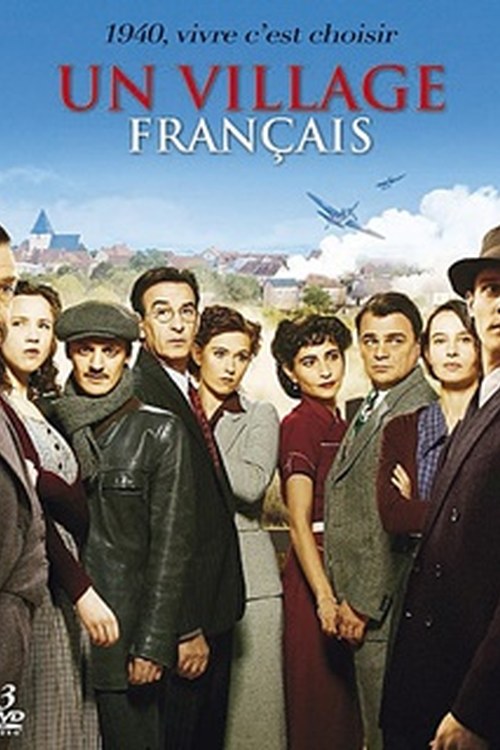
A French Village · Season 1 · Episode 1 · 4 June 2009
S1E1 Episode 1
A sober premiere turns invasion into logistics, then lets one school decision become its first real wound.
THE MOMENT The moment of German arrival and the realisation among the village's inhabitants that normality will not return, and that each person's response to that realisation will define who they are.
The series opens on the German arrival in Villeneuve in June 1940 and immediately establishes its moral seriousness. The German occupation is rendered not as theatrical villainy but as administrative fact, and the first decisions the villagers face - accommodation, evasion, or confrontation - are shown to carry weight that will accumulate across seven seasons.
Full episode analysis below. Spoiler-light verdict above.
Updated
The telephone line matters before the German advance does. As soon as service returns, someone wants the Besançon depot called for more drugs. Chickens remain stuck at Lons-le-Saunier. The town is already speaking in shortages, routes, and permissions before gunfire turns errands into risks. That is the premiere’s cleanest instinct: invasion arrives first as administration under pressure. BollyAI's read: the episode works best when it treats history as a system failure, where a missing delivery, a forbidden panic, a police visit, and a school outing can become life-and-death events by sunset.
The War Arrives as a Phone Call
The opening stretch is built around logistics, a smart first move. Instead of a grand speech about occupation or heroism, the episode gives us drugs, poultry, a restored telephone line, and the careful sorting of what counts as vital. The town is not a battlefield in the big cinematic sense yet. It is a place trying to keep its small machinery running while the larger machinery of war bears down on it.
That makes the early warning about panic important. The instruction not to spread certain information frames the hour’s moral weather. Information is power here, and a hazard. Say too much and the village may break before the Germans arrive. Say too little and people make decisions without knowing the danger around them.
The premiere’s thesis sits inside that tension. It cares less about the spectacle of collapse than the paperwork of collapse: who can call whom, who has medicine, who gets told the truth, who gets kept calm. That restraint gives the first episode a grounded texture. The war is partly offscreen, but its pressure already shapes every sentence.
The limitation is visible too. With so many functions introduced through errands and urgent messages, some early beats can feel like a municipal crisis board. Still, the approach has a point. Before the bullets arrive, the town is already losing control.
Birth Under Surveillance
The episode tightens its grip by placing childbirth beside policing. the Police enter while investigating a Communist cell formed in the area. That beat changes the air. The danger is no longer only military. The village’s internal order is already being tested by surveillance, suspicion, and suppression.
The childbirth material gives the hour its strongest human counterweight. A delivery begins and continues while authority keeps moving through the frame. The line “Stand up please,” attributed to Unknown, lands with blunt procedural force because it arrives near the start of that transition. A body is in crisis, a baby is coming, and the world still insists on commands.
By, the delivery has reached its critical moment. The baby’s head is visible. Afterward, the child is identified as a boy and a name is requested. The episode earns that simple question because it places new life inside a collapsing civic order. Naming a child should be ordinary. Here it becomes an act performed while roads, phones, police, and guns keep intruding.
This is where the premiere’s best craft lives: it refuses to isolate private life from public danger. The birth does not stop the political plot. The police investigation does not stop the birth. The episode keeps them in the same room of anxiety, and the overlap is more effective than any speech about innocence.
Monsieur Schwartz Chooses Movement
Monsieur Schwartz emerges as the episode’s clearest figure of practical response. The dossier places him inside medical logistics early and later inside the effort to navigate chaos. He is associated with access, urgency, and the need to move people when the situation turns. That gives him a useful dramatic shape. He is framed first through action, not ideology. with firing everywhere, a man insists the children be taken on foot through back lanes. The beat is simple and strong. Vehicles, main roads, and obvious routes become liabilities. Survival shrinks down to feet, alleys, timing, and local knowledge. Panic can look like a quick change in route.
The character contradiction around Marceau sharpens that section. He wants to avoid danger and stay safe, yet ends up caught in the shooting sequence and is later described as dead. The arc is plain, but efficient. Caution offers no guarantee once the town’s geography turns hostile.
Here, the episode’s dialogue density helps. Emergencies generate speech: instructions, questions, updates, orders. Then the noted silences around early and mid-to-late stretches let the consequences sit for a moment. The rhythm is uneven in places, but the unevenness suits the material. People talk because they need to act. Then they stop because the situation has outrun language.
The School Outing Becomes the Moral Wound
The harshest material gathers around the children. after an order not to move, a child named Michaël is mentioned as dead. Later, the explanation is made explicit: the school class was machine-gunned by an aircraft, and three died. The episode does not need to inflate that beat. The fact is enough.
The central contradiction around Monsieur Fournier gives the tragedy its human target. He wants to decide and proceed with an outing at a dangerous time without accountability. Later, the outing is described as unauthorized by someone else, and blame is placed on his decision-making. That is the episode’s sharpest moral arrangement: the war commits the violence, but local decisions still matter.
This is where the premiere becomes more than a chain of emergency incidents. It asks how responsibility works when the scale of danger is too large for ordinary people to understand. If Fournier did not know enough, why did he decide? If someone else later calls the outing unauthorized, why was the structure loose enough for it to happen? The hour leaves those questions open, which is right for a premiere. It plants them.
The open loop around Gustave adds a quieter dread. A missing child after a machine-gunned class is no puzzle-box tease. It is a practical terror. Who saw him last? Which route did he take? Who can still be contacted? The final telephone request matters because coordination now has a body count behind it.
The Verdict
“A French Village” opens with a strong governing idea: history enters through ordinary systems before it becomes remembered as history. The first episode is at its best when it tracks phones, drugs, police inquiries, back lanes, and school decisions as the machinery of survival. Its weaknesses come from the same design. Some early logistics are dramatically dry, and a few transitions lean on function more than character. But the childbirth sequence, the police intrusion, Marceau’s failed safety, and the school-class tragedy give the premiere a firm spine. BollyAI's read: this is a solid, sober opening that trusts consequences over noise. As a season starter, it plants useful questions about Gustave, the hill explosion, and the village’s next move once the telephone becomes available.