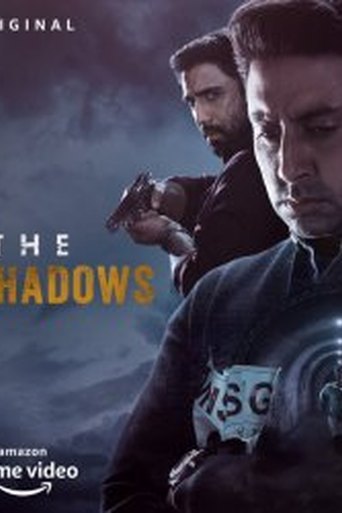
Breathe: Into the Shadows · Season 1 · Episode 4 · 10 July 2020
S1E4 Episode 4
The investigation side of the episode hums with quiet momentum, but the early hostage scene fizzles and the silences sometimes feel more like padding than patience.
A hostage standoff opens with real adrenaline - Kabir Sawant with a gun, a demand, the first visceral pulse of the season - then fizzles as the episode pivots to a post-mortem report and a call history. The swap is revealing. This hour works best when it slows down: the Allahabad caller thread and a looming video message are well-placed...
Full episode analysis below. Spoiler-light verdict above.
Updated
A man storms into a room, demanding a girl’s release. By the time the scene ends, Kabir Sawant has a gun, a threat, and the hour’s first real pulse. Then the standoff fizzles, and the episode quietly pivots to a post-mortem report and a call history. The swap is telling. This hour works best when it stops chasing action and starts sifting through evidence.
The Hostage Scene Arrives Early and Leaves Too Soon
The episode opens on chaos: an unknown visitor at the door, a shout of “Hey, let her go!”, and Kabir’s immediate lunge into protector mode. The geography of the room is never fully felt, but the raw panic is there. Kabir’s demand, “Let her go,” and his subsequent warning to anyone who might fire first, paint a man whose instinct is to save the girl without bullets. That internal contradiction is the hour’s sharpest character sketch, but the sequence burns through it in under three minutes. Just as the tension tightens, the hostage-taker vanishes from the narrative, leaving the rest of the episode to wonder what exactly just happened. BollyAI’s read: the show treats a high-wire opening like a checkbox, not a detonator.
The Post-Mortem Becomes the Real Engine
A forensic report lands on the table with the line, “Sir, this is Pritpal’s latest post mortem report that you asked for.” The procedural grind begins, and the show exhales. This is where Breathe Into the Shadows finds its rhythm: the dull fluorescents, the clipped shorthand of cops scanning data, the slow linking of Pritpal’s death to some larger pattern. Investigators suspect a connection between victims, and the hour suddenly feels less like a thriller and more like a puzzle being assembled in real time. The long silences that fill the corridors, noted in the episode’s own rhythm, work here because they mirror the mental blank spaces of a team staring at a whiteboard. The episode earns its best minutes not through confrontation but through scrutiny.
The Call History and the Missing Hour
A breakthrough disguised as routine: “This is Pritpal Singh’s call history.” The detail that snags is the unknown caller from Allahabad, ringing an hour before the man died. The hour plants this elegantly, letting the number sit there like a splinter. What makes the beat effective is that no one over-explains it; the audience is left to clock the anomaly alongside the team. BollyAI’s note: the show finally trusts its audience to connect a dot. It’s the kind of breadcrumb that feeds the season arc without pausing for a lecture, and it turns a flat procedural moment into genuine intrigue.
Long Silences, Uneven Rewards
The dossier flags long silences, 40 to 158 seconds of dead air, as a tonal signature. When those silences cushion a discovery like the call history or the post-mortem exchange, they build a meditative dread that suits a story about a killer who weaponises absence. But when they bracket the hostage scene’s abrupt exit or the thin discussion about “harassing him, disturbing him, calling him,” the silence feels like the show buying time. The motive theory discussion, which should crack the case open, instead circles a vague notion of harassment without landing a concrete hook. The criticism is precise: the episode relies on quiet to signal depth, but depth requires detail, not just stillness.
A Voice on the Phone, a Message for the Masses
One line, spoken with a killer’s clarity, resets the stakes: “A message which he wants to deliver to the people at large.” The call history wasn’t just a lead; it was the killer’s first broadcast. The episode ends with the video the management plans to air hanging over everything like an unread headline. That open loop gives the hour’s final moments a genuine tension, the kind the hostage scene only pretended to have. BollyAI’s read: the show is better at planting bombs than detonating them, and this episode is almost entirely planting. That’s a strength and, in a series marketed as a thriller, a quiet liability.
The Verdict
The hour’s investigation sequences carry a procedural patience the earlier hostage theatrics could not sustain. The Allahabad caller and the looming video message are well-placed hooks, and the forensic rhythm is clean when it trusts silence over noise. But the opening standoff is a misfire, and the motive discussion drifts where it should sharpen. For a series trying to map a killer’s psychology, the episode feels caught between a whodunit pace and a psychological slow-burn, delivering on neither with full confidence. BollyAI’s score: a 6.8, solid groundwork that needs a more ruthless edit and a steadier hand on silence. Season arc awareness: the hour plants crucial threads, but its real work is still waiting to bloom.