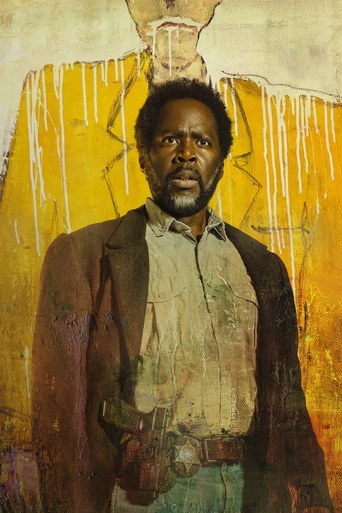
From · Season 2 · Episode 7 · 4 June 2023
S2E7 Belly of the Beast
The episode converts radio mystery and worm logic into real specimens, then undercuts every control instinct with bodily intrusion.
THE MOMENT The worry, spoken plainly: not the monster, the thing that killed it. Boyd's cure becomes the town's newest fear.
A dead creature on a table and a town deciding whether to look inside it. The dissection hour doubles as a referendum on every relationship in the cast: Kenny refuses to stay in the room and names the gap between love and solidarity on his way out. Donna hands Fatima the season's best line, a miracle is just the other...
Full episode analysis below. Spoiler-light verdict above.
Updated
The radio doesn’t just warn them. It knows them. That detail turns every fear of “someone’s playing with us” into a specific threat, and the opening stretch makes the village feel less like a prison than a lab calibrated to its subjects.
Kristi hears the same logic in the group’s urgency that Boyd keeps trying to hide behind. When Boyd finally stops hiding long enough to bleed in public, the episode’s central question comes into focus. If this place can speak through radios and bodies, can anyone weaponize it without giving it more leverage?
A Signal With Teeth
The opening move is the radio voice that knew personal details, and it lands as more than a creepy hook. It is leverage. The characters hear it on the radio, and the mystery immediately changes what “help” means in this town. When the clue is just “a voice,” paranoia stays abstract. When the clue is “the voice knows,” paranoia becomes instruction.
That matters because it sets up the episode’s core tension around agency. Boyd and Kristi are not only reacting to danger. They are deciding what to do with information that may already be controlled. Even the structure supports that unease. The rapid alternation between dialogue-heavy confrontations and quieter character beats creates the feeling of interruption, as if something outside normal human planning keeps cutting in and redirecting events.
The sharpest beat comes later, when Jade asks why the earlier call for help was ignored. Her question is not cosmic. It is procedural, almost accusatory in its simplicity. If someone answered, why didn’t anyone act like it mattered? By then, though, the episode has trained the viewer to doubt every answer the world offers. The radio voice is a breadcrumb. It is also a reminder that breadcrumbs can be bait.
Worm-Blood as a Gamble, Not a Plan
Boyd’s arc runs on risk calculus. No safe options. He is trying to turn his worm infestation into a tool, and the episode makes that clear through action and line. He attempts a transfusion and says, “My blood is your blood now, motherfucker.” The line is ugly on purpose. It marks desperation, not heroism, and frames the decision as the transfer of something dangerous that cannot be contained.
What makes the beat work is the contradiction underneath it. Boyd wants his worm-blood kept secret and used as a weapon, but the moment he involves anyone else, he exposes himself. That exposure pays off when Kenny later reveals the explanation that justifies Boyd’s horror-science logic. Kenny says, “You had worms or something crawling underneath your skin,” confirming that Boyd’s body is not merely sick. It has been altered by whatever rules govern this place.
The episode’s argument is not that Boyd has a great plan. It is that every attempt to forge a weapon here also invites scrutiny. Boyd gives the creatures a reason to study him. The transfusion is the moment he tries to seize control of that relationship. The later bile discovery is the moment the relationship answers back.
That is where the hour gets its real traction. From keeps asking whether the town’s rules can be used against it without feeding the system more data. Boyd pushes hardest on that question, and “Belly of the Beast” refuses to flatter him for it. His gamble may matter. It also widens the opening.
Kristi’s Choice to Bring the Monster Inside
Kristi serves as the episode’s moral hinge because she is the person most equipped to recognize reckless experimentation, and still chooses it. On paper, she should be the one stopping any plan that gets people killed. Instead, she makes the decision that drags the threat across the threshold. Kristi says, “Let’s bring it in.” The line is the episode’s quiet pivot. It transforms the hour from mystery and suspicion into anatomy and consequence. The script likes this kind of turn. A calm, practical choice lands, then immediately acquires procedural weight. She brings the creature inside. The show moves from fear of the unknown to the physical labor of investigation.
That investigation pays off in a way that feels useful and ominous at once. The group finds bile in the creature and treats it as a possible weapon. Plotting-wise, it is a clean convergence point. The earlier radio mystery and Boyd’s worm logic suddenly produce something tangible. But the emotional cost sits with Kristi. Even if the bile offers an advantage, bringing the monster inside proves the point her protective instincts cannot defeat. The town gets inside them one way or another.
This is one of the hour’s strongest ideas. Safety plans keep collapsing the moment opportunity appears. Kristi wants to protect the group by avoiding fatal experiments. She also recognizes that passivity offers no protection. The episode does not present that as hypocrisy. It presents it as the town’s pressure system at work. Curiosity is dangerous. Refusing curiosity is dangerous too.
That tension gives the middle section its pulse. The episode keeps converting abstract fear into material evidence, then stripping that evidence of any clean sense of control. Kristi does the right practical thing for the wrong moral comfort. She gets answers. She also invites contamination, physically and psychologically, into the center of the group.
Donna’s Pregnancy and the Place’s Personal Territory
The hour’s most destabilizing reveal arrives through medical impossibility. Donna tells Kenny, “I’m pregnant.” The shock comes in two layers. There is the revelation itself, and there is the emotional frame around it. Donna wants to understand the impossible pregnancy, but fears the place is torturing her. The disclosure plays as confession and plea, delivered to someone who can hold the information without immediately turning it into a project.
This beat changes how the earlier tensions read. The radio mystery and Boyd’s worm weaponry initially feel external. Donna’s pregnancy makes the threat intimate. If the radio voice can know personal details, and Boyd’s body can be compromised from within, then “medically impossible” does not register as a stray twist. It feels like the next stage in a pattern of intrusion.
The pacing helps. After the earlier alternation between confrontation and relative quiet, Donna’s reveal lands like a quiet explosion. No chase scene is needed. No attack beat. The information alone reorients the stakes. Survival is no longer only a question of fighting creatures or decoding clues. It is also a question of whether the place can alter bodies, futures, and any stable sense of what is happening to them.
That is why the pregnancy reveal matters beyond shock value. It broadens the series’ field of control. The danger is not confined to the woods, the night, or the monsters’ feeding patterns. It extends into reproduction, medical reality, and the private corners of identity. The episode takes territory that should remain personal and makes it part of the town’s experiment.
It also circles back to Kristi’s bind. Everyone keeps trying to convert fear into action. The place keeps converting their bodies into evidence. Donna’s reveal is the clearest expression of that exchange, because there is no tactical upside attached to it yet. It simply exists, impossible and invasive, and forces the group to consider how much of themselves is still their own.
The Verdict
“Belly of the Beast” argues that From’s most effective mechanism is information that behaves like control. The radio clue, with its personal knowledge, establishes that threat early. Boyd tries to turn worm-blood into a weapon. Kristi’s decision to bring the creature inside turns suspicion into physical evidence through the bile discovery. Donna’s impossible pregnancy then makes the intrusion personal and pushes the group’s crisis past tactics.
The episode’s craft is strongest when every attempt at control becomes another exposure point. It rewards curiosity with concrete substance, then punishes that curiosity with deeper uncertainty. That pattern gives the hour momentum and keeps its mysteries from floating away into abstraction. “Belly of the Beast” advances plot, but its sharper achievement is tightening the show’s underlying logic. This place does not only trap people. It studies them, answers selectively, and turns every useful discovery into another reason for fear.
Score (bollymeter): 7.8/10