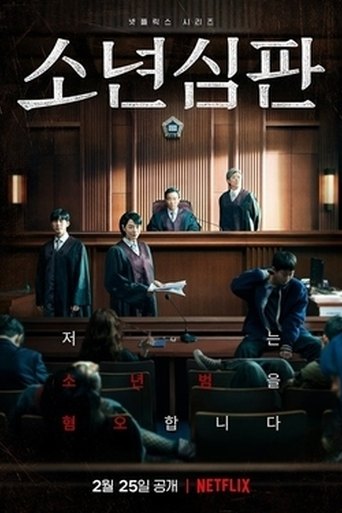
Juvenile Justice · Season 1 · Episode 1 · 25 February 2022
S1E1 Episode 1
Episode 1 turns courtroom procedure into moral pressure, forcing Judge Sim’s contempt to collide with systemic reality and lived complexity.
THE MOMENT The judge delivers her opening verdict without flinching - a declaration of bias that sets the entire season's dramatic engine.
Before the courtroom even fully warms up, Judge Sim Eun-seok arrives with a posture that isn’t just authority. It’s contempt with a schedule. The hour makes her certainty feel rehearsed. She treats juvenile offenders like a category, not a life. Then the casework around her start
Full episode analysis below. Spoiler-light verdict above.
Updated
COLD-OPEN: The gavel that already decided
Before the courtroom even fully warms up, Judge Sim Eun-seok arrives with a posture that isn’t just authority. It’s contempt with a schedule. The hour makes her certainty feel rehearsed. She treats juvenile offenders like a category, not a life. Then the casework around her starts behaving like a living machine. People talk like they are surviving. Paperwork reads like a history of shortcuts. The show’s first move is simple and brutal: it plants the idea that Judge Sim thinks she is doing justice, while the system around her keeps doing something else entirely.
The Verdict Starts as a Smile, Then Turns Into Evidence of Cruelty
BollyAI's read: Episode 1 works because it doesn’t begin with a twist. It begins with a judge who can’t imagine being wrong, and it forces the viewer to watch her certainty collide with human mess. This is a courtroom series that uses procedure like a spotlight. The plots we get in the first hour are not just “cases,” they are stress tests for Judge Sim’s worldview. And the craft is in the sequence of discomfort: the show makes you feel how easy it is to mistake stiffness for standards.
The stern judge’s real crime is moral laziness
The episode’s central tension is that Judge Sim Eun-seok does not simply believe juvenile offenders are dangerous. She believes her job is to identify them, label them, and move on with clean hands. That might sound like “strict parenting” in a different genre, but here it lands as moral laziness. She speaks and acts like the story is already finished. The courtroom becomes an assembly line, and she is the inspector who never doubts the product.
Beneath her professional confidence, there is a hard emotional pattern: she treats hardship as something that should have been avoided, as if life’s failures are choices with clear labels. That is why the show spends time on the atmosphere of her introduction. The writing lets her enter the room with a ready-made judgment, then shows how quickly the room refuses to cooperate.
### BollyAI craft callout: Flat confidence as dramatic irony The episode weaponizes dramatic irony. You can predict Judge Sim’s reactions because they are consistent, but consistency is exactly what becomes dangerous. The show is arguing that prejudice can be procedural. Not loud prejudice, not villain monologues. Quiet, administrative contempt. That’s scarier. It is also why the series feels “legal” without turning into a case-of-the-week template.
When the system talks, it sounds like excuses with signatures
Courtroom drama often pretends the system is neutral. Juvenile Justice does the opposite from minute one. The episode introduces institutional friction as its own antagonist, even when no one person is fully villainous. Rules exist, but they are not arranged to produce truth. They are arranged to keep the machinery moving.
This is where the family court setting matters. It isn’t just backdrop. It shapes every interaction. People speak in fragments, documents carry the emotional weight like they are meant to, and “process” becomes a way for responsibility to evaporate. Judge Sim’s contempt hits the brick wall of how often the institution’s goal seems less like rehabilitation and more like containment.
And the hour makes a specific thematic promise: juveniles are not the only characters trapped by the system. Adults are, too. The court’s structure limits what anyone can do, even as it demands moral certainty from those who work inside it.
### BollyAI craft callout: Procedure as ideology The writing turns procedural beats into ideology. The questions asked are not just about facts. They reflect what the court values. The episode’s early conversations are built to show that “what we can prove” is not the same as “what we should understand.”
Juvenile cases are framed as lives, not files
A legal series can get lazy when it includes young characters. It can reduce them into plot devices or cautionary tales. Here, Episode 1 tries to resist that reduction, at least in its framing choices. The episode treats juvenile offenders as people whose behavior has context. Not “excuses.” Context.
The show also understands something crucial about juvenile justice stories: the stakes are not just what happens to the teen in the next hearing. The stakes are what the adults decide the teen is. Judge Sim’s worldview tries to flatten that complexity immediately. The episode pushes back by showing that the narrative around a juvenile is usually written by adults who do not fully own their own failures.
Where the episode bites: it starts with certainty and ends with doubt
There’s a moment-to-moment escalation in Episode 1 that doesn’t rely on melodramatic shouting. It’s quieter. Judge Sim’s interactions begin to misfire. The episode places her in situations where her assumptions do not match the evidence of lived experience. People do not behave like “case types.” They behave like people.
That friction becomes the episode’s earned turn. The show doesn’t rush into redemption. It makes doubt feel unsettling, even slightly humiliating, because Judge Sim is not used to being challenged. And that means the hour doesn’t just introduce her character. It reveals the series’ thesis through her discomfort: if justice is only certainty, it will always choose the easier story.
### BollyAI craft callout: The character turn is the plot turn In many courtroom shows, the case moves the characters. Here, the characters move the case because their biases determine what gets treated as “relevant.” That is why the first hour feels like a setup even when it’s already delivering emotion. The setup is not backstory. The setup is a worldview collision.
Pacing that earns tension without exhausting you
Episode 1 is paced like a first day of work that becomes a first day of confrontation. It avoids the common trap of dumping all its thematic ideas at once. Instead, it uses repetition as pressure: Judge Sim returns to her assumptions, and the courtroom keeps answering differently. Each procedural step becomes another chance for her to either adapt or insist.
The craft here is restraint in the writing’s emotional volume. It lets the court environment do the heavy lifting. Even when nothing “explosive” happens, the tension is active. You can feel it because the episode makes you watch how information is requested and refused. That is where the discomfort lives. It’s not just what happens in court. It’s what court allows to be seen.
The Verdict
Juvenile Justice starts Season 1 by arguing that juvenile justice fails when adults confuse authority with understanding. Episode 1 introduces Judge Sim Eun-seok as a judge with contempt packaged as professionalism, then forces the system’s excuses and the juveniles’ complexity to puncture her certainty. The episode is strongest when it treats procedure as ideology and treats a “case” as a life being processed for someone else’s comfort.
This is also the series’ best season-arc promise in miniature: Judge Sim’s contempt will not survive contact with repeat patterns, because the show is building a long case against the institution, not just against individual wrongdoing. The first hour plants the question that will keep returning: if the court is designed to move quickly, can justice ever move toward the truth?