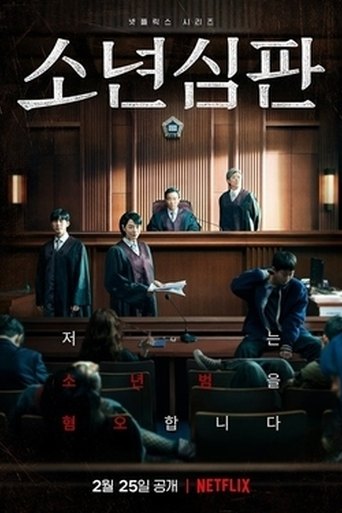
Juvenile Justice · Season 1 · Episode 10 · 25 February 2022
S1E10 Episode 10
Episode 10 turns courtroom closure into an institutional bruise, forcing Eun-seok to trade contempt for responsibility without any clean win.
THE MOMENT The Judge delivers her closing statement - a reckoning with her own transformation over ten episodes.
The hour opens on a verdict still wet with moral confidence, and then quietly humiliates it. The case that’s supposed to settle the system ends up exposing how little “justice” can do when evidence, power, and fear decide the meaning of the truth.
Full episode analysis below. Spoiler-light verdict above.
Updated
Juvenile Justice S1E10: "Episode 10" Review
Spoiler-light verdict above. Full episode analysis below.
The hour opens on a verdict still wet with moral confidence, and then quietly humiliates it. The case that’s supposed to settle the system ends up exposing how little “justice” can do when evidence, power, and fear decide the meaning of the truth.
The verdict as a bruise, not a cure
Judge Sim Eun-seok has built her entire identity on contempt that sounds like clarity. In the season’s closing hour, that contempt is treated like a tool with a worn edge. The writing does not ask her to suddenly become soft. It asks her to notice the difference between being right in principle and being effective in practice.
This episode lands the core thematic reversal: the system does not break because one bad actor exists, or because one hearing was mishandled. It breaks because procedure is not neutral when the people inside it have different leverage. Eun-seok’s confidence repeatedly collides with delays, coercions, and the bureaucratic habit of choosing the least complicated outcome. The drama could have used shock value to finish strong. Instead, it uses process fatigue as heartbreak.
The show’s sharpest move here is tonal economy. The season has trained viewers to expect courtroom scenes to be the arena where moral clarity wins. Episode 10 makes the arena feel smaller. Even when Eun-seok does the “right” thing, the system rearranges the cost onto someone else’s body, reputation, and future. The verdict that closes this hour feels less like closure and more like bruised accounting.
Who gets to define “truth” when everyone’s afraid
The episode keeps circling the same question: when stakes are high, who controls the narrative of what happened? That power is not only held by lawyers or judges. It lives in family pressure, institutional thresholds for “credible” testimony, and the way fear turns speech into evidence.
The writing makes the courtroom feel like the last stage of a longer coercion. What gets presented as fact is shaped by who was allowed to speak, how many times they were questioned, and whether their words can survive the translation from human emotion into legal language. Eun-seok is trying to do justice through a lens that assumes rational adjudication. Episode 10 shows that adjudication is often a ritual for deciding which version of events can be made administratively legible.
This is why the emotional center of the hour is not the loudest argument, but the smallest collapses. A child’s statement is not just a statement; it is a fragile object that can be mishandled, repeated wrong, or reframed until it no longer resembles the original truth. The episode argues that the legal process can become a machine that converts panic into “inconsistency,” and inconsistency into dismissal.
A season finale that refuses the comfort of clean villains
Season 1 establishes a classic legal structure: wrongs are committed, files are filed, and truth is supposed to eventually emerge. Episode 10 does not reject that structure. It rejects the comfort that structure is enough.
Instead of delivering a simple villain reveal, the episode spreads blame across roles. The adults who should protect children often behave like risk managers. The institution behaves like a system trained to reduce uncertainty. Even when Eun-seok pushes against it, she is not immune to the institution’s gravity. She is a magistrate, not a god. The show’s finale makes that limitation feel like ethics, not weakness.
That is the craft tension of Episode 10: Eun-seok’s growth can only go so far inside a framework that rewards compliance. The hour sharpens her earlier contempt into something more honest. Not gentleness. Not forgiveness. Just clarity about the difference between “a bad person broke the rules” and “a whole environment taught people to break themselves.”
So when the episode reaches its closing beats, it lands a harder kind of resolution. It offers not a triumphant moral win, but the aftermath of moral work. Justice, here, is portrayed as a verb that exhausts the body and still does not guarantee the outcome you want.
Pacing as pressure: how the ending earns its sting
The episode’s pacing is designed like a tightening belt. Rather than sprawl, it compresses attention around what can be verified, what can be argued, and what can be proven. That compression does two things at once: it mirrors the legal logic of “what counts,” and it makes Eun-seok’s human reactions feel increasingly out of sync with courtroom time.
The writing is disciplined about momentum. It avoids dragging every thread to a neat wrap. If a subplot needed a full resolution to feel satisfying, the episode either omits the detour entirely or treats the unresolved part as meaningful. That is not laziness. It’s an intentional stylistic choice. The finale’s rhythm suggests that the real world does not pause for your narrative comfort.
Where the episode could feel punishing is also where it is most effective. The story keeps returning to consequences that cannot be undone. That is the sting: the system can correct paperwork without correcting the damage that paperwork enabled. Episode 10 wants viewers to feel how a courtroom can be “successful” and still fail the people it claims to protect.
The last transformation: contempt becomes responsibility
Judge Sim Eun-seok does not exit the season as a different person in makeup and posture. She exits as someone who has learned what responsibility looks like when it is not rewarded.
Early in Season 1, her contempt functions like a boundary. It keeps her emotionally clean by turning juveniles into categories. Episode 10 forces her to confront how that boundary is built on ignorance disguised as authority. The finale does not erase her judgment. It refines it into something harder to perform: patience under uncertainty, persistence without spectacle, and an insistence that process should serve people, not protect the institution’s self-image.
If there is a criticism to land cleanly, it’s this. The episode’s moral argument sometimes leans on the feeling of inevitability. When the system is this resistant, a viewer can start to anticipate outcomes rather than be surprised by them. The show’s emotional engine still works, but the suspense can thin in places where the writing is already certain about its thesis.
Still, Episode 10 earns its final emotional note by not pretending the judge’s evolution equals societal transformation. Eun-seok can grow, and the institution can still refuse to change. That contradiction is the point.
The Verdict
Episode 10 is a legal finale that chooses abrasion over catharsis. It argues that juvenile justice fails not just through bad decisions, but through the way the system trains people to treat children’s humanity as administrative risk. Judge Sim Eun-seok’s journey lands less as a redemption arc and more as an ethical recalibration: contempt is replaced by responsibility that no longer expects the institution to cooperate.
As a season-arc sentence, this hour closes Season 1 by proving the show’s central gamble: courtroom drama can be sociological without losing emotional clarity, and justice can be truth-seeking without ever guaranteeing vindication.