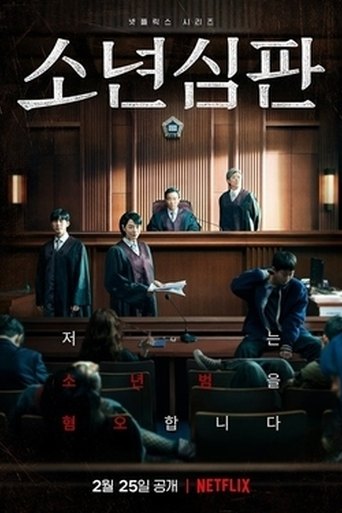
Juvenile Justice · Season 1 · Episode 9
S1E9 Episode 9
Episode 9 treats court procedure like a comfort blanket for cruelty, forcing Judge Sim to grieve the limits of fairness.
The hour pivots on Judge **Sim Eun-seok** learning that the system does not “misjudge” children so much as it predicts their ruin and then calls the outcome justice. **Kang In-woo**’s casework and the court’s paperwork gravity collide with **Seo Woo-jung**’s quiet refusal to be r
Full episode analysis below. Spoiler-light verdict above.
Updated
spoiler_free
The hour pivots on Judge Sim Eun-seok learning that the system does not “misjudge” children so much as it predicts their ruin and then calls the outcome justice. Kang In-woo’s casework and the court’s paperwork gravity collide with Seo Woo-jung’s quiet refusal to be reduced to a file. The episode’s strongest craft move is how it makes legal process feel like weather: you can study it, but it still soaks into the bones. Where it frays slightly is the way it compresses moral reckoning and consequence into a tight late-season rush.
review_body
### COLD-OPEN The episode opens with the kind of moment that looks procedural but lands emotional. Judge Sim Eun-seok pushes forward as if the law is a clean instrument, then watches the room tilt against her through what people choose not to say. A child’s “behavior” gets explained as if it were evidence, not context. The court’s tone stays calm, but the subtext is violence. This is the hour where the show stops asking whether Judge Sim can be fair, and starts asking whether fairness is allowed to survive contact with institutions.
### THESIS This episode argues that juvenile justice fails not because it lacks rules, but because it turns human complexity into categories early, then protects those categories with paperwork later. Judge Sim’s growth is the emotional engine, but the true antagonist is the system’s habit of making answers before it makes understanding.
The Verdict-as-Method: Paperwork That Smiles While It Cuts
The show has been building toward this: Judge Sim Eun-seok begins the season treating juvenile offenders like moral problems. By Episode 9, she’s forced to see the calmer version of that mistake. The episode’s courtroom machinery is not chaotic. It is orderly. And that order becomes the knife.
What makes this hour hit is its focus on how a decision is assembled. The court does not simply “reach the wrong conclusion.” It collects the wrong inputs, then allows those inputs to masquerade as neutrality. The writing makes this feel chillingly mundane. Reports, interviews, statements. The language of “risk,” “habit,” “absence of remorse,” and similar legal shorthand turns life into a chart. Judge Sim notices the pattern, but the system’s defense is that it is following procedure. The tragedy is that the procedure has already decided what kind of truth counts.
This is where the episode’s emotional pivot becomes craft. Instead of one big monologue about injustice, it shows injustice as a workflow. BollyAI’s read: the show’s craft choice is to make you feel how easy it is to believe you are doing the right thing when the form is written that way.
Who Gets to Be a Child: The Episode Lets Kids Pass as Adults, Then Punishes Them for It
The legal premise of the series has always been, in part, a fight over scale. How much do you credit a child’s immaturity, and when does immaturity become an excuse? Episode 9 sharpens the dilemma by showing that the system rarely grants the benefit of doubt. Instead, it toggles between two unfair modes: treat the child like an adult when it helps justify certainty, then treat them like a victim when it helps justify delay.
Kang In-woo’s presence in the episode reinforces that the “case facts” are never just facts. They are interpretations shaped by the adult world’s needs. Meanwhile, the writing keeps pulling attention to how adults talk about children. People label them. People generalize them. People forecast their futures with confidence they have not earned.
Bollywood melodrama tends to let compassion arrive in a single beat. This show resists that comfort. It makes the compassion arrive slowly, through painful contradictions. The episode’s best dramatic pressure comes from watching Judge Sim Eun-seok try to grant humanity in the space where the court demands predictability. She can empathize, but she still has to sign something that will live longer than her empathy.
A Quiet Counter-Law: Seo Woo-jung Makes Compassion Look Like Evidence
If Judge Sim Eun-seok represents the law learning to feel, then Seo Woo-jung represents feeling learning how to survive in court.
The episode treats Woo-jung not as a saint, but as someone who has learned the discipline of speaking in ways the system can carry. She pushes back without theatrics. Her role is one of translation: turning lived experience into a form that can challenge the court’s pre-decided narratives.
Craft-wise, the episode builds tension by alternating between what the court wants and what Woo-jung provides. The court wants clarity and closure. Woo-jung offers texture. And texture is harder to dismiss, but easier to ignore. That means the conflict is not just legal. It is rhetorical. The episode shows Judge Sim realizing that legal truth is sometimes a matter of whether someone can testify in a language institutions respect.
The episode also uses Woo-jung to expose a softer cruelty: the system often tolerates empathy only when it does not threaten outcomes. Woo-jung’s presence suggests that if compassion becomes a tool for reclassification, it is already too late. BollyAI’s read: the show keeps insisting that justice is not “understanding that happens after a decision,” it is “understanding that changes what the decision can be.”
The Judge’s Collapse Is Not Doubt, It Is Grief
Late in the episode, Judge Sim Eun-seok’s growth takes a harsher shape than moral victory. She doesn’t simply learn to be kinder. She learns that her certainty had emotional convenience built into it.
Earlier in the season, the judge’s contempt for juvenile offenders functions like armor. Episode 9 treats the removal of that armor as loss. The episode’s writing makes her realization costly. She confronts how many people can be failed by the same mechanism, and how often the court can tell itself the failure was caused by the child’s nature instead of the system’s design.
This is why the episode’s emotional tone turns from reformist to mournful. It is not that Judge Sim becomes ineffective. It is that she becomes aware of the scale of what cannot be fixed by one good ruling.
Bollywood rule-of-thumb dramas often end with redemption. This show ends with reckoning. The “judge who despises juvenile offenders” premise was always a setup, but Episode 9 reframes it: the contempt was never just about children. It was about the judge’s need to believe the world is legible.
Pacing as a Weapon: The Hour Rushes Its Own Moral Gravity
Episode 9 is not sloppy, but it does feel pressure-cooked. The season has been laying track, and this episode is where the train accelerates toward consequence. That creates an earned intensity, but it also compresses some of the emotional beats. The moral questions deserve more breathing room than the plot gives them, especially when the show has to juggle multiple strands of responsibility across court actors and support systems.
BollyAI’s honest critique: when the episode gathers its revelations late, the writing asks the viewer to process both systemic indictment and personal transformation at once. It works as propulsion. It risks trimming the pause where transformation can land with full weight.
Still, the episode is persuasive precisely because the show refuses to let anyone take refuge in pacing-friendly optimism. The rush is part of the theme: institutions move on deadlines, not on healing.
The Verdict
Episode 9 earns its place in the season by turning legal procedure into the show’s true villain. The hour argues that juvenile justice fails through categorized certainty, not through absence of rules, and it forces Judge Sim Eun-seok to grieve the fact that fairness is harder than she once believed. The strongest craft choice is how the episode makes compassion procedural, then shows the limits of compassion when the inputs are poisoned. The weakest choice is the late compression of moral consequences, which slightly blunts the emotional settling time. Still, the arc lands: this season does not offer a single heroic ruling. It offers a judge who finally understands what the law cannot fix alone.