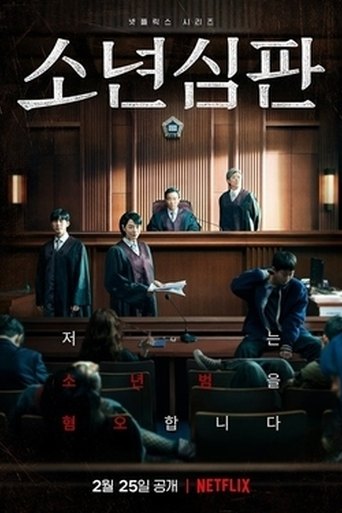
Juvenile Justice · Season 1 · Episode 8
S1E8 Episode 8
S1E8 turns courtroom procedure into moral evidence, forcing Judge Sim to trade contempt for responsibility that the system cannot guarantee.
A child’s future gets argued like a case file, and Judge **Sim Eun-seok** refuses to accept that this is “how it has to be.” The courtroom energy turns from deliberation to friction as the system’s answers feel pre-written and the human harm feels delayed. The hour’s central move
Full episode analysis below. Spoiler-light verdict above.
Updated
COLD-OPEN
A child’s future gets argued like a case file, and Judge Sim Eun-seok refuses to accept that this is “how it has to be.” The courtroom energy turns from deliberation to friction as the system’s answers feel pre-written and the human harm feels delayed. The hour’s central move is simple: it forces everyone to look at what their procedures actually protect. Then it punishes them for the comfort they tried to keep.
## The Hour Turns Sympathy Into Evidence
This episode keeps dismantling the same illusion Judge Sim Eun-seok has built her career on: that contempt is clarity. Up to now, her authority has acted like a solvent, burning through excuses. But by S1E8, the writing stops letting her win by volume or conviction. The hour is about how the law treats a child not as a person with a moving timeline, but as a category with an expiry date. And the episode’s big craft decision is that it makes that harm repeatable in the viewer’s mind, not shocking once and forgotten.
The show’s procedural spine remains intact. There are hearings, testimonies, and the familiar choreography of family court logic. But the episode uses those beats to ask a sharper question than “Is the offender guilty.” It asks “Who benefits from a verdict that pretends the past is fixed.” That shift matters because it reframes Judge Sim’s arc from personal growth into systemic accusation. Her certainty used to be a scalpel. Here, it becomes a possible lie, because the system can absorb any moral stance and still produce the same outcome.
BollyAI's read: the hour is at its strongest when it lets procedure masquerade as neutrality, then shows it failing in slow motion. The courtroom feels less like a stage and more like a pressure chamber, and the episode keeps tightening that pressure until people say things they will later wish they could retract.
## A Judge Learns the Hard Math of “Best Interest”
Judge Sim Eun-seok is still, fundamentally, a judge who wants rules to work. This episode tests the specific limitation of that temperament: when “best interest” becomes an instrument rather than a principle, the judge has to decide whether to bend or break. The show avoids making that decision heroic. Instead it makes it exhausting. Paperwork, attendance issues, dependency dynamics, and the gaps between what adults claim they can provide and what they actually provide. Everything is bureaucratic, but the emotional arithmetic is brutal.
The episode also clarifies something about the show’s moral architecture. Judge Sim is not becoming “soft.” The writing is too honest for that. She becomes more dangerous to the system because she becomes more specific. Her questions stop being about whether a child “deserves” compassion and start being about whether the court can prove it is doing anything other than transferring risk. That is where the episode earns its tension. Sympathy alone cannot fix an institution. Sympathy without evidence becomes just another kind of performance.
BollyAI’s read: S1E8 gives Judge Sim the scariest lesson possible. It is not that her beliefs are wrong. It is that her beliefs are irrelevant if the system is built to run on inertia.
## The Child Case Isn’t the Only Trial
One of the episode’s stealth achievements is how it spreads the sense of wrongdoing beyond the obvious target. It places guilt in the gaps: in what adults say they did, what they documented, and what they conveniently did not. In other words, the “juvenile case” becomes a prism that exposes multiple failures at once.
That’s also where the supporting cast carries more weight than usual. Yang Kyung-min (the child at the center of the court’s emotional storm, as the season has been building toward) is not just a plot device. The episode leans into how the court’s framing can swallow a child’s context. Prosecutor and defense strategies, likewise, start to feel less like adversarial truth-seeking and more like optimized positioning. The courtroom argument becomes a contest over who gets to narrate reality.
BollyAI’s read: the writing wants the viewer to feel uncomfortable not just about the offender, but about the adults who treat harm like a negotiable detail. The episode makes that discomfort purposeful by making every side believe they are doing the best they can. Then it shows the cost of that belief when resources are missing, incentives are wrong, and accountability is diffuse.
## Procedural Friction: When Rules Start Biting Back
S1E8 is smart about pacing. It does not sprint into its most emotional moments. Instead, it milks friction: repeated questions, missing context, slow clarifications, and the way legal language can launder emotional violence. The craft move is that the hour keeps returning to the same procedural objects, making them feel heavier each time. A form is not a form anymore. A timeline is not a timeline anymore. The episode turns these details into moral evidence.
There is also a thematic contradiction the episode refuses to solve neatly. The system insists it is protecting children, while its outcomes show otherwise. The episode forces Judge Sim to operate inside that contradiction. That is why her confidence frays in this specific hour. Not because she doubts children need support. Because she starts doubting the court’s ability to deliver it consistently.
BollyAI’s read: this is one of the season’s key procedural episodes because it shows law as an ecosystem. The judge can be brilliant, the questions can be sharp, and the rulings can be principled. But if the ecosystem is starved or corrupted, every principled act becomes a limited tool. The episode’s emotional voltage comes from watching that limitation land.
## The Season-Arc Push: From Contempt to Responsibility
By Episode 8, Judge Sim Eun-seok has moved beyond personal growth as a mood. The season arc is now about responsibility that can survive systemic defeat. She has to keep deciding what to do when her work cannot immediately rescue anyone. That is a harder transformation than learning empathy. It requires accepting that compassion is not a substitute for structural change, and that a single courtroom cannot fix the entire machine.
The episode also sharpens the stakes for the next stretch of the season by clarifying what “learning” costs. If Judge Sim’s earlier contempt was a defense against mess, then her new responsibility risks leaving her vulnerable to rage and exhaustion. The show does not let that vulnerability become melodrama. It keeps it professional. It keeps it procedural. And it makes her fight inside the room where power pretends it is neutral.
BollyAI's read: the hour is not just about what the judge understands. It is about what the judge can no longer pretend. That shift is why Episode 8 feels like a hinge rather than a chapter.
The Verdict
S1E8 is where Juvenile Justice tightens its thesis: legal procedure can look rigorous while still functioning as an emotional bypass. The episode’s best strength is how it makes Judge Sim Eun-seok confront the difference between moral certainty and actionable accountability. Sympathy is not enough, evidence is everything, and the system’s “best interest” rhetoric becomes suspect the moment it stops being measurable in outcomes.
Where the hour can feel slightly uneven is in how much it asks the viewer to sit with institutional weight before it delivers a clean moral release. But that discomfort is the point. The season arc moves forward by forcing the judge to carry complexity, not solve it.