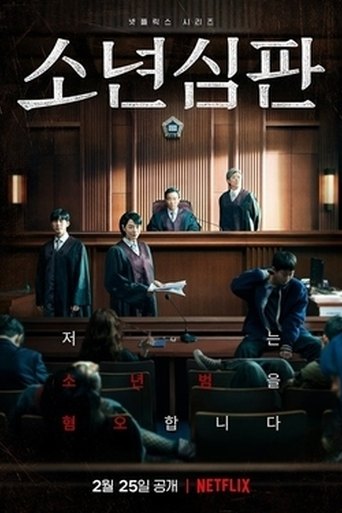
Juvenile Justice · Season 1 · Episode 7
S1E7 Episode 7
S1E7 turns courtroom procedure into moral pressure, forcing Judge Sim to trade contempt for harder, costlier accountability.
A mother waits with a face that has already decided how the courtroom should end. In the family court’s bright, functional quiet, the question is not whether a child committed wrongdoing. The question is whether the system will keep calling harm “an accident” when it keeps repeat
Full episode analysis below. Spoiler-light verdict above.
Updated
COLD-OPEN
A mother waits with a face that has already decided how the courtroom should end. In the family court’s bright, functional quiet, the question is not whether a child committed wrongdoing. The question is whether the system will keep calling harm “an accident” when it keeps repeating the same patterns. Judge Sim Eun-seok tries to treat the case like a clean line from act to consequence, but the hour keeps dropping evidence that refuses to sit still. BollyAI’s read: this episode tightens the legal screws and then shows you the parts behind the door.
The Verdict
Verdict: A legally disciplined episode with an emotionally inconvenient pulse. It moves the casework forward with courtroom logic and procedural restraint, yet it never allows the show’s central thesis to stay abstract. The hour’s best choice is how it treats “choice” as a moving target shaped by poverty, pressure, and adult negligence. BollyAI’s criticism is specific: the writing sometimes reaches for clarity where the story needs lingering moral discomfort, and a couple of beats land a little too clean for the mess they describe. Still, the hour works because it doesn’t just ask what happens to one juvenile case. It asks what kind of judge can survive being repeatedly proven wrong.
The Whole Courtroom Is a Mirror, Not a Stage
Judge Sim Eun-seok enters the episode with the posture of certainty: the belief that juvenile delinquency can be evaluated, categorized, and sentenced into moral order. That posture is the show’s engine. In earlier episodes, Eun-seok’s disdain is a kind of legal shorthand, a way to keep empathy from interfering with procedure. Here, the hour begins turning that shortcut against her.
The procedural architecture matters because the show is not interested in courtroom drama as entertainment alone. The writing uses structure to pressure her worldview. Evidence gets presented, testimony has to be interpreted, and the legal questions force characters to translate messy human lives into admissible facts. That translation is where Eun-seok’s arrogance becomes a weakness. The episode keeps letting her treat “who is at fault” like a binary, then interrupts that binary with the way context floods in through every gate: the child’s environment, the adults’ choices, the uneven availability of care. The result is that Eun-seok’s contempt starts to look less like justice and more like denial with a robe on.
The Case Keeps Becoming a System Story
The episode’s core craft move is to expand the radius of each legal decision. The juvenile offender is never just a kid “in trouble.” The hour frames the child’s behavior as a symptom of adult behavior and institutional neglect, which means the court cannot remain a neutral arena. The parents or guardians function like variables in a human equation, not as villains in a moral fable. When the show shows harm repeating, it makes “one bad act” feel like the last link in a chain rather than the whole chain.
This is where the episode earns its ambition. Legal storytelling often tempts writers into treating each case like a self-contained problem: resolve it, learn a lesson, move on. Juvenile Justice does something more uncomfortable. It makes the courtroom feel like a sorting machine that always underestimates how much damage already happened before anyone filed a report. BollyAI’s read: the episode’s momentum comes from its refusal to let the legal system off the hook. Every time the trial logic tries to close the book, the show adds another page from the same underlying file.
Accountability Without Simplification
A lot of shows want the viewer to believe in accountability. This one wants something harder: accountability without pretending the facts are simple enough to carry the weight we demand from them. Prosecutors, defense counsel, social workers, and court staff become different lenses on the same human mess. The episode uses their friction to reveal how “due process” can still produce outcomes that are unfair in practice.
Eun-seok’s central trial becomes internal as well. Her certainty is challenged not only by new information but by what that information implies about the system she’s helping run. If delinquency is partly shaped by conditions that adults and institutions created, then punishment cannot be the only form of response. Yet the court also cannot become a sentimental forum where responsibility dissolves into excuses. The hour keeps forcing that contradiction to sit on the judge’s desk, visible and unavoidable.
BollyAI’s criticism lands here: the episode occasionally smooths the emotional logic of certain moments to keep the trial moving. Juvenile Justice is at its strongest when it allows discomfort to linger. When the story fastens onto clarity too quickly, the messiness it gestures at risks becoming a theme rather than a pressure.
A Judge Learns How to Be Afraid of Her Own Answers
Judge Sim Eun-seok is not merely learning facts. She is learning the limits of how she interprets facts. The episode’s tension is that her job requires decisive conclusions, but the story keeps demonstrating that decisive conclusions can be moral mistakes when they are built on contempt. Eun-seok’s disdain was never neutral; it filtered everything she saw. When the case resists her interpretation, the hour turns her contempt into a liability.
The performance and writing work together here. The judge’s behavior, even when she remains procedurally correct, begins to reveal a different internal state: not doubt as weakness, but fear as an ethical reaction. She has to confront the possibility that her certainty has harmed children even when it was dressed as justice. BollyAI’s read: this is the episode where the show starts treating the judge like a character who could become better, but only through painful unlearning.
Tenderness, Then Mercilessness
The episode is careful about tone. It gives you moments that feel humane, then punishes the viewer for getting comfortable. The juvenile and their immediate circle are placed in situations where compassion is not a feeling but a consequence of resources, access, and adult action. When those supports are missing, kindness becomes something the system talks about rather than something it reliably delivers.
This is the episode’s emotional method. It refuses the comfort of “everything worked out because the court cared.” Instead, it shows how care without structural change can become performative, and how policy without empathy can become cruelty with paperwork. BollyAI’s read: the show’s mercilessness is not spectacle. It is the quiet realization that legal outcomes can be correct in form while wrong in effect.
The Verdict
This episode is a disciplined legal hour that keeps expanding into an indictment of how systems manufacture “bad kids” from bad conditions. It advances the central casework while transforming Eun-seok’s arc into a moral test: can a judge keep her authority without relying on contempt? The best moments are the ones that insist on moral ambiguity inside procedural clarity. The main flaw is pacing clarity in a couple of beats that should probably feel thornier and slower. Still, the hour earns its place because it tightens the show’s core argument: juvenile justice cannot be a temperament, it has to be a practice, and the episode shows how hard that practice is when the institution keeps failing first.