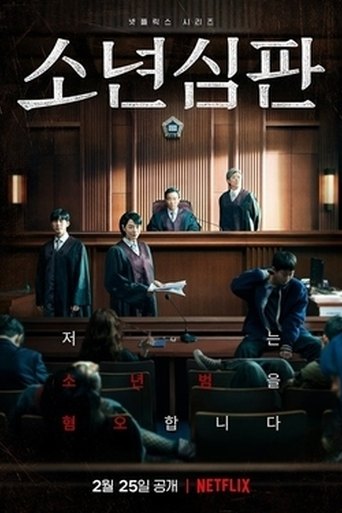
Juvenile Justice · Season 1 · Episode 6
S1E6 Episode 6
S01E06 turns paperwork into a weapon, and forces Eun-seok to learn that legal clarity can still be moral blindness.
This hour turns a routine court day into a moral stress test. A vulnerable child case gets processed like a file, not a person, and **Judge Sim Eun-seok** is forced to sit with the gap between what the law can do and what it refuses to see. The episode’s best work is structural:
Full episode analysis below. Spoiler-light verdict above.
Updated
spoiler_free
This hour turns a routine court day into a moral stress test. A vulnerable child case gets processed like a file, not a person, and Judge Sim Eun-seok is forced to sit with the gap between what the law can do and what it refuses to see. The episode’s best work is structural: it keeps shifting the burden of proof from the kid to the system, then lets Eun-seok’s certainty crack in public. BollyAI’s read: the writing is most powerful when it denies easy catharsis. Where it slips is the temptation to compress too many emotional beats into one procedural pocket.
review_body
### COLD-OPEN A child stands in front of the bench with a story that does not fit neatly into “intent” or “character.” Judge Sim Eun-seok listens with the same guarded severity she always brings, but the more the court asks, the more it reveals how badly the process is built for human mess. The hour opens on the simple cruelty of procedure. It is not that anyone wants harm. It is that the system runs on categories, and the categories keep losing the kid.
### THESIS S01E06 argues that juvenile justice fails hardest when it tries to be efficient, because efficiency rewards documentation over understanding, and Eun-seok’s growth depends on watching that trade happen in real time.
The episode does not need a villain monologue. Its antagonist is the machine: schedules, intake language, standardized risk framing, and the quiet assumption that truth is what fits the record. Eun-seok enters with contempt for juvenile offenders, but by this point the show has her confronting a sharper question. Not “are the kids guilty.” Instead: “who benefits from calling uncertainty a refusal.”
A verdict that wants paperwork more than pain
The cold procedural spine is the craft move here. Judge Sim Eun-seok treats testimony like evidence, and evidence like a ladder she can climb to certainty. That ladder is built from documents, prior records, and the kind of “clarity” courts like because it travels cleanly into decision-making. But this episode makes a point of showing how easily “clarity” becomes an excuse to stop looking.
The writing’s most cutting technique is contrast. The courtroom demands that everyone be legible. The people on the stand, especially the child at the center of the case, are not legible in that way. Their behavior is inconsistent because their lives are inconsistent. Their fear reads as defiance. Their gaps read as manipulation. The hour keeps showing how the court’s demand for coherent narration turns into a second punishment.
This is where Eun-seok’s contempt becomes thematically expensive. She has always believed attitude correlates with culpability. In S01E06, the show forces her to confront the opposite possibility: that attitude can be an adaptive survival tactic, and that the court’s interpretive habits are as biased as any personal prejudice.
The system offloads guilt onto the kid
Legal drama often treats “the system” as a vague antagonist. Here it is something more specific and more frightening. It is process. When the episode leans into this, the court becomes less a temple of truth and more a sorting facility.
What BollyAI’s read finds effective is how the hour shifts the pressure points. Instead of the system interrogating itself for why it missed the child’s needs earlier, it uses the record to blame the child for failing to match the record. The episode frames that logic as administrative convenience. The court wants closure. The file wants an ending.
The show’s cruelty is that efficiency looks neutral. The documents are “objective.” The timeline is “factual.” The risk assessment is “standard.” The violence comes from the way those tools can flatten a life into a decision. And S01E06 keeps returning to the same emotional math: the child pays for adult negligence twice, first through neglect, and then through the court’s misreading of that neglect as personal failure.
Eun-seok’s challenge is not simply moral. It is professional. Her reputation as a strict judge is tied to her ability to render verdicts. This hour asks whether rendering a verdict is the same thing as understanding the person whose life it changes.
Eun-seok’s crack is public, not private
There’s a difference between character growth that happens in isolation and growth that happens under scrutiny. S01E06 chooses the second. Judge Sim Eun-seok does not merely doubt herself in a quiet moment. She meets resistance. Her instincts collide with the evidence the system provides, and with the institutional habits that interpret everything through procedure-first lenses.
The episode makes Eun-seok’s transformation feel earned by structuring her confrontations as choices, not realizations. She can default to the easiest reading. She can treat the case as another test of “responsibility” and punish accordingly. Or she can accept that her model of juvenile offenders is incomplete and that the missing pieces are not just “information,” they are failures of structure.
This is where the show’s legal ambition shows its craft. The episode does not rely on speeches. It relies on discomfort. Every time Eun-seok tries to anchor a decision in what the court has, the hour offers another contradiction: a detail that suggests the record is incomplete, or a pattern that suggests the system’s interventions came too late or in the wrong form.
When compassion becomes the only admissible truth
The most moving work in S01E06 is the way it turns compassion into a kind of legal method. Not sympathy as sentiment. Compassion as a disciplined insistence on context.
The show’s direction in this hour keeps returning to the gap between what “the law says” and what “the law can only infer.” Eun-seok learns that juvenile court is not just about adjudicating misconduct. It is about deciding what kind of future the system is allowed to offer a child. That shift is not soft. It is hard because it removes the option of pretending that punishment is the same thing as protection.
If there is an emotional strategy at play, it is restraint. The episode avoids the trap of making every scene a breakthrough moment. It lets Eun-seok’s empathy be partial at first, then more credible as she recognizes the child’s humanity is not a rhetorical flourish. It changes what she demands from the record. It changes what she questions. It changes the tone of the questions she asks from the bench.
Pacing as pressure: a dense hour that fights for breath
Craftwise, S01E06 is built like a closed room that keeps filling with smoke. Procedural beats stack quickly, and the emotional beats arrive in clusters. That density is not automatically a flaw. In legal dramas, urgency can feel like realism.
But this hour also flirts with compression. When too many stakes land in the same arc pocket, the episode risks making emotional catharsis feel like a schedule constraint. BollyAI’s read: the writing is at its strongest when it slows down just enough to let a contradiction breathe. There are moments where the episode’s momentum carries past its own most powerful question, and the result is that some turns land as “important” rather than “inevitable.”
Still, the overall effect works. S01E06 stays committed to the thesis that process is the antagonist, and that Eun-seok’s job is not simply to punish. It is to stop the machine from calling its omissions “facts.”
The Verdict
S01E06 is a legal episode that treats efficiency as the moral problem. It argues that juvenile justice collapses when it prioritizes documentation over understanding, and it uses Judge Sim Eun-seok’s public authority to measure what the system tries to hide. The hour’s best scenes do not chase a neat emotional payoff. They show how categories, timelines, and standardized interpretations can become a second assault on a child already shaped by institutional neglect.
Season-arc wise, this episode sits exactly where the series needs it: Eun-seok’s contempt is no longer just personal hardness. It is now an investigative blind spot the show can dismantle. S01E06 plants the lesson that her authority matters most when she refuses to treat the file as a person.