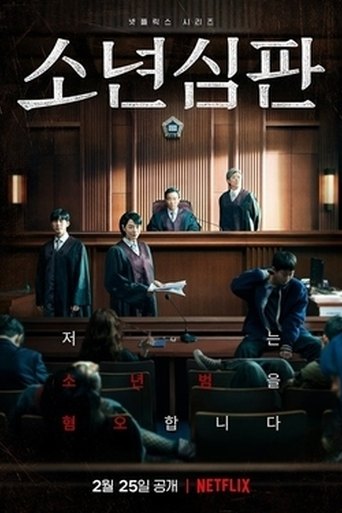
Juvenile Justice · Season 1 · Episode 5
S1E5 Episode 5
S01E05 exposes juvenile justice as an input problem: evidence gets arranged, then called truth, forcing Judge Sim’s certainty to fail.
A kid in the dock is treated like a case number first and a person second. In the space where a verdict should be clean, **Judge Sim Eun-seok** keeps asking questions that are too basic to be comforting. Everyone else in the room, from court procedure to office habit, seems train
Full episode analysis below. Spoiler-light verdict above.
Updated
Cold-Open: The courtroom behaves like a courtroom, until it doesn’t
A kid in the dock is treated like a case number first and a person second. In the space where a verdict should be clean, Judge Sim Eun-seok keeps asking questions that are too basic to be comforting. Everyone else in the room, from court procedure to office habit, seems trained to absorb human mess without letting it change anything. Then the hour starts doing something quieter and meaner than cross-examination: it forces the judge to notice that “evidence” can be a story, not a fact, and that the system’s idea of justice is sometimes just its ability to close files on time.
Why this hour matters: the writing takes sympathy and makes it actionable
BollyAI’s read: S01E05 is where the show stops being about whether Judge Sim Eun-seok can feel for juvenile offenders and starts being about whether she can fight for them inside a machine that has no incentive to slow down. The episode sharpens its legal pulse by tightening the chain from allegation to investigation to paperwork, and it uses that chain to expose the judge’s real vulnerability: certainty is a coping mechanism, not a principle.
The evidence isn’t neutral, it’s arranged
Judge Sim Eun-seok walks in with a moral grammar that assumes delinquency is a category with edges. But this episode treats “proof” like a corridor the system controls. The procedural beats do not simply move the plot. They show how juvenile cases are handled when time, staffing, and liability matter more than nuance. The writing keeps returning to the same discomfort: if the court only gets what the bureaucracy is willing to produce, then the court’s “findings” are only as honest as the pipeline feeding them.
That is why S01E05 feels more juridical than earlier hours. It is not a sermon on empathy. It is a demonstration of how empathy collapses when you rely on processes that were never designed to be empathetic in the first place. The judge’s questions keep landing, and they keep meeting the same wall. Someone will call it procedure. Someone will call it precedent. BollyAI’s read: the script is really calling it convenience.
Life at the edges of the file: children as outcomes, not clients
If earlier episodes introduced juvenile offenders as moral puzzles, S01E05 makes them operational problems. The kids are not allowed to be contradictory without punishment. Their defenses do not get to breathe. Their traumas do not get translated into context without friction.
The show’s legal ambition matters here, because it refuses the lazy contrast between “good child” and “bad child.” Instead, it places the child inside a network of adult choices: guardianship failures, reporting incentives, and institutional risk management. When the system wants closure, it can treat a child’s explanation like a nuisance, not a clue. When it wants liability protection, it can treat uncertainty like waste.
BollyAI’s read: the hour is emotionally sharp because it never lets the audience forget the practical consequence of all this. The child does not experience ideology. The child experiences an outcome that is already being drafted before the full story is told.
The judge’s recalibration is gradual, not cinematic
There is no single “turn” scene where Judge Sim Eun-seok suddenly becomes a different person. Instead, S01E05 builds its transformation through accumulated irritation and then accumulated doubt. The judge’s contempt is not magically removed; it is tested until it starts to look less like justice and more like armor.
The episode also gives her opponents sharper texture. Court staff and institutional gatekeepers do not play cartoon antagonists. They behave like people trained to survive within constraints. That is where the writing hurts, because it makes the system’s failure feel both deliberate and mundane. BollyAI’s read: the hour understands that cruelty can be procedural. The judge’s job is to catch that cruelty, but procedure helps it hide.
Her moral confidence erodes the way paper burns. Slowly at first, then all at once when you realize how close you were to the flame.
Who benefits from speed: the system’s real verdict
S01E05 makes the episode’s central argument with pacing and structure: when the court system privileges speed, it also privileges the easiest narratives. Juvenile cases often require time to interpret. Time to evaluate context. Time to follow up. Time to confirm that a child’s story is not being flattened by adult convenience.
But the hour keeps showing that “time” is treated like money, and “investigation” is treated like liability. That means the system’s incentives can quietly decide what counts as “truth.” The most damning craft choice here is that the show does not need a villain monologue. It just needs a chain of decisions that always leads to closure, even when closure is premature.
BollyAI’s read: the show’s legal thesis in this episode is that the system’s verdict is often decided before the judge speaks, because the inputs were already selected to minimize complexity.
The courtroom’s last cruelty is how it tries to sound fair
By the time S01E05 reaches its later beats, the episode has set up a specific kind of anger in Judge Sim Eun-seok. She is not only upset at outcomes. She is upset at language. Institutional phrasing can turn neglect into “lack of evidence.” It can turn missed opportunities into “process.” It can turn a child’s life into a clean chart line.
That is why the episode’s emotional peak feels less like an explosion and more like a tightening. The judge presses for what should be obvious, and the system responds with rationalizations that are technically correct and morally bankrupt. The writing uses the courtroom’s tone as camouflage. BollyAI’s read: the cruelty is that it is possible to appear neutral while doing harm.
And when a judge like Sim Eun-seok starts to see that camouflage, she is forced into the hardest question of all. Not “Do I feel compassion?” but “Can I do justice when the institution designs justice to be procedural and therefore limited?”
The Verdict
S01E05 is the legal-muscle episode where Juvenile Justice proves it can be both emotionally direct and structurally ruthless. It argues that juvenile justice fails less because individuals lack empathy and more because the system treats complexity as an administrative problem. The writing tightens the chain from evidence to narrative, and it uses Judge Sim Eun-seok’s doubt as the lens for that critique.
The score would land on how evenly the hour balances rage with restraint, because it asks hard questions without turning the courtroom into a fantasy of sudden reform. Season-arc wise, this is one of the clearest steps toward the series’ larger promise: certainty will keep breaking, and her job will keep becoming harder precisely because the stakes are human, not abstract.