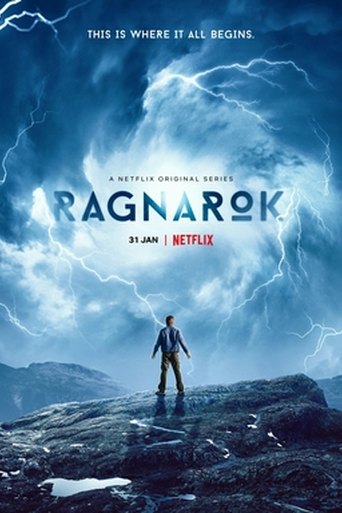
Ragnarok · Season 3 · Episode 2
S3E2 Episode 2
S3E2 turns Ragnarok’s mythology into grief-shaped perception, strengthening the town’s control theme while delaying the hour’s emotional payoff.
The town’s air still tastes like rust, the factory still claims it owns the horizon, and Magne still walks through it like a boy pretending he is not haunted. Then S3E2 does something Ragnarok does best and worst at once. It keeps the mythology machinery running, but it quietly s
Full episode analysis below. Spoiler-light verdict above.
Updated
Ragnarok S3E2: S03E02 Review
Teasing the Mirror, Then Refusing to Blink
The town’s air still tastes like rust, the factory still claims it owns the horizon, and Magne still walks through it like a boy pretending he is not haunted. Then S3E2 does something Ragnarok does best and worst at once. It keeps the mythology machinery running, but it quietly shifts the camera’s emphasis away from prophecy and onto perception. The episode builds scenes that feel like they should resolve into certainty. Instead, it keeps tightening the screws on the same question: if the conflict is partly imagination, what does it even mean when the monsters show up anyway?
spoiler_free
S3E2 stretches the new season’s psychological premise into day-to-day moves. It slows down key myth beats to focus on how Magne frames what he is seeing, and it turns family control, environment damage, and grief into a single braided threat. BollyAI’s read: the hour is at its strongest when it treats power as something that gets performed, not just inflicted. Where it stumbles is tonal timing. A few reveals feel like they arrive for atmosphere rather than propulsion, which makes the later emotional math harder to trust.
Who Is This Hour Really About?
This episode is, on paper, another step in Magne’s “I am Thor” escalation. In practice, BollyAI’s read is that Magne is less the center of gravity than the lens. The writing keeps returning to how he reacts, how he interprets, and how he lets certain symbols stand in for answers he is not ready to give. That shift matters because Season 3’s broader setup (the conflict framed through Magne’s comic book and grief) changes the genre contract Ragnarok has been playing with.
The episode uses the familiar Ragnarok rhythm: a “myth” moment followed by a grounded consequence. But S3E2 makes the grounded consequences feel slightly more psychological than physical. Indrids and the factory-family machine are treated as an ongoing pressure system, not just villains in control. Fjor and his social orbit sit closer to Magne’s internal weather than to a clean plot pipeline. Even when the show reaches for fantasy logic, the emotional emphasis lands on doubt and performance. It is not that the supernatural disappears. It is that the episode makes you suspect the supernatural might be the body grief borrows to talk.
BollyAI’s criticism is specific: when the hour leans too hard into ambiguity as style, it risks making characters react to feelings instead of making those feelings change decisions. Ragnarok can get away with that only if every ambiguity later cashes out. S3E2 toys with that tradeoff and does not fully commit to paying it off yet.
The Factory Doesn’t Just Poison Water. It Poisons Language.
The most Ragnarok thing about S3E2 is that it keeps translating the myth into industry. This time, the translation is subtler. Magne and Magda (and the broader town network) are forced to live inside a vocabulary shaped by the Jutul power structure. The “environment” thread is present, but it reads less like science-horror and more like social conditioning. The factory does not only contaminate the land. It contaminates what people are allowed to notice, what they call coincidence, what they treat as normal.
BollyAI’s read is that this episode understands the difference between threat and control. Threat is the monster. Control is the framing that makes the monster seem inevitable. The episode keeps you in scenes where speech, rumor, and selective silence carry as much weight as action. Even when the show gives you a myth-shaped beat, it often places the camera on how characters interpret the beat, not merely on the beat itself.
There is also a craft-level payoff here. Ragnarok has always loved “small town physics,” where big cosmology rides on petty routines. S3E2 leans into that by making the town’s systems feel self-reinforcing. If the mythology is entangled with Magne’s imagination, then the factory’s real-world power becomes the material his imagination can’t avoid using. That is a clever merging of the fantastical and the political, and the episode mostly earns it.
Grief as a Special Effect
Season 3’s premise turns grief into the most important supernatural ingredient. In S3E2, that idea becomes legible through character movement. Magne behaves like a boy who has learned to narrate his pain in myth terms. He does not only want answers. He wants the right story to hold his loss without collapsing. Ragnarok’s writing has always used symbolism, but this episode treats symbolism like a survival tool, not decoration.
BollyAI’s read: the hour’s emotional logic works best when the writing stops insisting on “revelation” and instead shows “ritual.” Characters fall into patterns. They chase meaning in familiar places. They try to make the town feel coherent. When the episode stages myth beats, it often uses them as mirrors for coping mechanisms. That is where S3E2 is strongest. It gives the season’s meta premise a human temperature.
But there is a danger. If the mythology is, at least in part, a grief-shaped construct, then every satisfying moment risks being undercut by the question of agency. Does the episode earn the right to ask that question and also deliver catharsis? S3E2 flirts with catharsis without fully granting it. That might be intentional, pacing for later payoff. Still, on the page, the episode can feel like it is building a feeling rather than a progression, which is a tricky balance in a season already wrestling with trust.
The Town Keeps Running, Even When the Myth Should Stop
Ragnarok’s universe is crowded: gods, giants, family conspiracies, and teenage relationships all compete for screen gravity. S3E2 chooses to make the town itself the engine. Even with Magne’s perspective in focus, the hour resists the “everything is in his head” trap by keeping outside consequences active. The factory family’s power still moves. People still make choices. Threat still arrives from systems that exist whether Magne believes in them or not.
BollyAI’s read is that the show is trying to walk a line between two truths: imagination can shape interpretation, while external harm can still be real. S3E2 advances that line by not letting the fantasy thread fully dissolve. Instead, it complicates it. The episode suggests that even if myth is a lens, the lens can still reveal something true about who holds power and how that power harms.
Craft-wise, this is where S3E2 earns respect. It keeps the pacing functional, with scene transitions that feel like cause and effect rather than montage. There is also a specific writing move: the episode uses repeated environments, the same industrial spaces, the same streets that “should” be mundane, and makes them feel like stages in a psychological play. That repetition reinforces the theme that control is cyclical.
The unevenness comes in how some moments are framed as if they are “big” but then behave like “mid.” If you are building toward a season recontextualization, Ragnarok needs momentum that feels necessary, not merely atmospheric.
The Verdict
BollyAI’s score leans solid but cautious because S3E2 performs a difficult job: it maintains Ragnarok’s supernatural mechanics while steering the season toward a grief-and-imagination framework that can destabilize everything that came before. This episode is at its best when it treats the factory-family regime as a control of language and attention, turning political power into a psychological effect. It is most emotionally credible when myth beats function like coping rituals for Magne rather than clean plot confirmations.
Where it slips is timing and payoff. The episode sometimes cultivates ambiguity as mood, and that choice can blunt propulsion. Still, as part of a season that is already asking viewers to renegotiate what “reality” means inside Magne’s story, S3E2 is a necessary step. It sharpens the lens, even if it refuses to show the full picture.