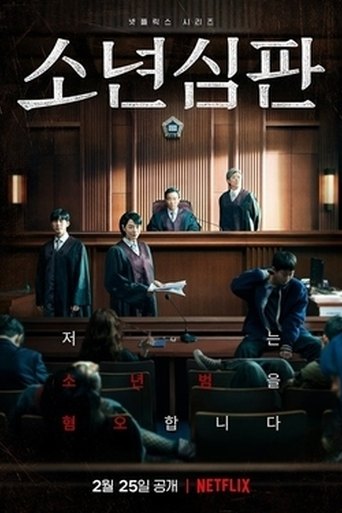
Juvenile Justice · Season 1 · Episode 3
S1E3 Episode 3
S1E3 turns Sim’s certainty into a legal problem, showing how context always beats contempt in juvenile justice.
A courtroom can look clean while everything underneath it is rotten. **Sim Eun-seok** walks into that contradiction with the same rigid posture she always brings, and the hour immediately tests whether her contempt is grounded in law or just in comfort. The casework is messy, the
Full episode analysis below. Spoiler-light verdict above.
Updated
Juvenile Justice S1E3: "S01E03" Review
Spoiler-light verdict above. Full episode analysis below.
### COLD-OPEN A courtroom can look clean while everything underneath it is rotten. Sim Eun-seok walks into that contradiction with the same rigid posture she always brings, and the hour immediately tests whether her contempt is grounded in law or just in comfort. The casework is messy, the testimonies are incomplete, and the people being judged carry histories that do not fit the judge’s neat moral categories. This episode refuses to let certainty survive the paperwork.
-
### ## The Verdict Is Already Written, Then the Hour Laughs at It The cleanest way to describe Juvenile Justice’s S1E3 is that it turns the concept of “a verdict” into a moving target. Sim Eun-seok does not arrive as a neutral functionary. She arrives as a person who believes she can correctly sort human beings by one axis: responsibility. In S1E3, that sorting fails because juvenile cases are not just about what happened. They are about what shaped the person who did it, and what the system did not do when it mattered.
The episode’s moral pressure comes from how procedure collides with context. The legal framework wants a tight chain of causality. The human reality offers ambiguity. Sim insists on clarity. The family court process keeps coughing up variables: gaps in supervision, failures across institutions, and the way adults evade responsibility by pushing consequences onto children. The writing’s argument is blunt: you can keep pretending the law is a scalpel, but in juvenile justice, it is often a bandage placed on top of a wound that has been untreated for years.
That is why the hour feels less like a single case and more like a test of the show’s thesis. The case materials strain Sim’s worldview, and the episode makes you feel how exhausting it is to rebuild a belief system from scratch while still doing the job on time.
-
### ## Evidence vs. Explanation: The Hour Forces Sim to Pick Her Side S1E3 is built on a specific courtroom problem: evidence can be “true” in isolation, but still misleading in meaning. Sim Eun-seok treats the file as if it is the whole story. The episode keeps puncturing that assumption by showing how legal facts without social context become convenient weapons.
On one level, the hour pushes standard legal friction. Juvenile cases depend on testimony that is partial, memory that is imperfect, and narratives shaped by fear. On another level, the hour goes sharper. It shows how adults can construct plausible explanations for themselves while minimizing the cost to the child. Even when the court reaches a procedural endpoint, the episode asks whether that endpoint is justice or just closure.
The tension peaks when Sim is forced to confront the difference between “what can be proven” and “what should be understood.” If she leans too hard on proof, she harms the child by flattening their circumstances. If she leans too hard on explanation, she risks excusing harm under the banner of sympathy. The show refuses to give her an easy lane, and it uses the legal discussion as character development, not as exposition.
BollyAI’s read: this episode is at its best when it turns courtroom reasoning into an emotional problem for Sim. She is not merely learning new facts. She is learning that her moral instinct has been trained to confuse order with fairness.
-
### ## A System That Outsources Pain The episode’s central cruelty is that juvenile offenders are not merely “kids who did wrong.” They are products of neglect, displacement, and institutional failure. S1E3 leans into that idea by making the system look busy and still ineffective.
Across the hour, the court process creates the illusion of action. Forms get filed. Hearings get held. Decisions get made. But the episode keeps insisting that holding meetings is not the same thing as changing outcomes. Children cycle through the same vulnerabilities, and the adults around them keep treating intervention like an afterthought.
What makes this work as drama is that it does not require the show to announce a villain. The failure is structural, not personal. That means Sim Eun-seok can no longer comfort herself with the belief that the problem is a specific bad actor. If the process is already designed to miss what matters, then her earlier certainty becomes not just harsh but misguided.
BollyAI’s critique is simple and sharp: the hour sometimes stretches the scope of its indictment so broadly that the courtroom turns into a philosophy lecture in a robe. When the writing leans too hard on systemic diagnosis, it risks reducing some secondary figures to thematic tools. Still, the emotional core holds, because the show is not just diagnosing institutions. It is showing the cost paid by the child who has no power to opt out of the machine.
-
### ## The Juvenile Offender as a Person, Not a Lesson S1E3 is interested in how quickly society turns children into symbols. One of Sim’s first instincts is to treat offenders as evidence of a moral decline. The episode counters that by foregrounding the child’s interior life, their contradictions, and their survival logic.
The writing’s smartest move is that it does not ask the viewer to “forgive” wrongdoing on command. It asks for something harder: the willingness to see how a child can be both harmful and harmed, both capable of choice and constrained by circumstance. This is not a request for sentimentality. It is a demand for precision.
When Sim Eun-seok gets pulled toward empathy, the show makes sure it is not a sentimental conversion. It looks more like a professional collapse of her old categories. She begins to realize that her contempt has been a shortcut. Contempt is easy because it avoids the hard work of understanding causality in human lives.
BollyAI’s read: the episode is deliberately uncomfortable because it makes the court feel like a place where compassion is not a mood but a discipline. The hour suggests that to judge a juvenile fairly, you must accept complexity without turning it into an excuse.
-
### ## Tenderness, Then the Court’s Hard Edge For all its thematic weight, S1E3 still understands that legal drama needs pressure, not just insight. The episode stages moments where Sim Eun-seok appears to soften, and then makes sure the consequences are immediate. That pattern is the show’s craft signature: emotion is never a blanket. It is a choice with outcomes.
The episode’s hardest beats are the ones that show the distance between what the court wants to fix and what society is willing to fund, supervise, or sustain. Even when the judge starts to see the child as a person, the hour underlines that the system will not suddenly become humane because one magistrate develops a conscience.
That is why the episode’s ending mood matters. S1E3 does not feel like a clean resolution. It feels like a continuation of the larger season arc: Sim is being forced to interrogate the moral certainty she used to lean on, and that interrogation is ongoing, not ceremonial. The court’s hard edge stays in frame even as Sim changes. The show is basically telling you that growth without institutional change is just a different kind of suffering.
-
The Verdict
S1E3 argues that juvenile justice cannot be reduced to punishment plus paperwork. The episode does not simply “humanize” offenders. It puts Sim Eun-seok in legal situations where her contempt stops being a tool and starts being a liability, because the casework exposes how often systems fail before courts even arrive. The writing is at its strongest when it treats courtroom reasoning as moral labor, not procedural routine, and when it shows how empathy becomes a disciplined response to evidence that never tells the full story.
Score cannot be grounded per-episode without verified data, but craft-wise this hour pulls its weight. It advances the season’s central arc by tightening the conflict between one judge’s certainty and a system built to outsource its responsibility.